
Albania remains one of the Mediterranean's most rewarding self-drive destinations, combining dramatic mountain geography with Ottoman architecture and clear Ionian waters. Operating your own rental car gives you direct access to hillside fortresses, coastal canyons, and historic villages that regional minibuses (furgons) reach only with complex schedules.
This seven-day route traces an efficient loop from Tirana through the UNESCO-listed city of Berat, across the Llogara mountains to the northern Albanian Riviera, down to the ancient ruins of Butrint, and back north along central inland expressways. Here is how to plan the route, manage regional driving quirks, and optimize your daily schedule.

Essential Driving Logistics & Regulations
Driving in Albania is straightforward on primary highways, but secondary mountain corridors demand sharp concentration and conservative pacing. Familiarize yourself with key regional standards before leaving the rental depot:
- Licensing Requirements: According to U.S. Department of State travel guidelines for Albania, foreign motorists must hold both a valid domestic driver’s license and an International Driving Permit (IDP) issued under the 1949 Geneva Convention to drive or rent a car legally.
- Rules of the Road: Traffic drives on the right, and seatbelts are mandatory for all passengers. Mobile phone use is strictly prohibited while driving unless using a hands-free kit.
- Emergency Protocol & Fines: If you are involved in a collision, do not move the vehicle unless it poses an immediate hazard to other traffic. Dial 112 immediately to report the accident and wait for the traffic police to issue an official report. Official police traffic citations are issued as written tickets—never pay cash directly to an officer on the roadside.
- Night Driving: Avoid driving through mountainous regions and unlit rural routes after dark. Unlit road segments, unmarked construction patches, and wandering livestock are common hazards outside major urban centers.
- Tolls & Currency: Most major roads are toll-free, with two notable exceptions on or near this route: the 250 ALL toll plaza on the new Thumanë–Kashar motorway segment near Tirana International Airport, and the modern bypass through the Llogara Tunnel, which charges standard passenger vehicles 250 ALL per crossing. Keep small Albanian Lek (ALL) cash bills handy, as roadside card terminals can experience occasional cellular connectivity drops.
Day 1: Modern & Historical Layers of Tirana
Morning: Skanderbeg Square & Central Landmarks
Collect your rental vehicle at Tirana International Airport (TIA) or an inner-city depot. If collecting from the airport, park your vehicle at your accommodation first, as Tirana's dense city center is best navigated on foot.
Begin at Skanderbeg Square, the focal point of the capital. Walk around the monumental equestrian statue of national hero Gjergj Kastrioti Skanderbeg, visit the delicately painted 18th-century Et'hem Bey Mosque, and view the Clock Tower. Stroll down the pedestrianized Toptani Street to view the exterior remains of Justinian's fortress (the Castle of Tirana), now repurposed with regional craft shops and casual eateries.
Afternoon: Subterranean Cold War History
Drive or take a short taxi ride east to Bunk'Art 1, situated along Rruga Fadil Deliu on the lower slopes of Mount Dajti. Housed inside the massive, multi-level underground bunker constructed during the 1970s for dictator Enver Hoxha and the military high command, this site presents a comprehensive overview of 20th-century Albanian political history.
Check the official Bunk'Art visiting schedule, which runs Monday through Thursday from 09:30 to 16:30, and Friday through Sunday from 09:30 to 17:30. If your timing is constrained, you can opt for Bunk'Art 2 in the city center; combined tickets covering both installations remain valid for 72 hours.
Evening: Coffee Culture in Ish-Blloku
Spend your evening walking through Blloku, a leafy neighborhood once sealed off exclusively for Communist Party elites. Today, the area is the capital's culinary hub. Settle into an outdoor café terrace or dine on regional dishes such as tavë kosi (baked lamb with spiced yogurt and rice) before resting for the drive south.
Day 2: The Ottoman Quarters of Berat
- Transit Time: Approximately 2 hours (125 km via SH4 / SH85 / SH72)
Morning: Scenic Route to the Osum River Valley
Depart Tirana after breakfast, heading south toward Durrës before swinging inland along the SH4 corridor toward Lushnjë and Berat. The roadway transitions into undulating hills alongside the Osum River valley.
Upon entering Berat, known as the "City of a Thousand Windows," head directly toward your lodgings. If your hotel is located within the ancient upper castle walls (Kala), verify parking protocols in advance: inner castle lanes feature steep, polished limestone cobbles, and casual day-trip parking inside the fortress gates is restricted to residents and permitted guests.
Afternoon: The Citadel & Onufri Iconographic Museum
Ascend the stone path to the Kala (Berat Castle), a sprawling defensive complex that remains continuously inhabited. The fortress grounds offer 360-degree views across the valley, Mount Tomorr, and the red-tiled roofs below.
Within the citadel walls, explore the Church of the Dormition of St. Mary, which houses the Onufri Iconographic Museum. Open daily from 09:00 to 19:00 during the high season (May through October), this museum exhibits post-Byzantine masterworks by the 16th-century master painter Onufri, famous for his signature vibrant red pigment, alongside an intricately carved wooden iconostasis from 1807.
Evening: Mangalem & Gorica Architecture
Before dusk, walk down through the historic Mangalem quarter to cross the stone Gorica Bridge. From the opposite bank in the Gorica neighborhood, you get the classic postcard vista of Mangalem's vertically tiered white houses, whose oversized windows reflect the evening light. Dine along the pedestrian boulevard (Bulevardi Republika) during the lively evening xhiro (traditional communal walk).
Day 3: Crossing the Mountains to the Ionian Coast
- Transit Time: 2.5 to 3.5 hours (approx. 140 km from Berat to Himarë via Vlorë)
Morning: Berat to Vlorë
Depart Berat early, driving west via Fier to connect with the coastal hub of Vlorë. This leg marks the dividing line between the shallow Adriatic coastline and the turquoise, mountainous Ionian shore. Stop along the Vlorë waterfront for espresso before taking the coastal highway south past Radhimë and Orikum.
Afternoon: The Llogara Pass vs. Llogara Tunnel
At the foot of the Ceraunian Mountains, drivers face a choice:
- The Modern Llogara Tunnel: Opened to bypass the treacherous hairpins, this 5.9 km infrastructure shortcut cuts the drive from Dukat to Palasë down to approximately 7–10 minutes. Standard passenger cars pay a 250 ALL toll.
- The Classic SH8 Mountain Pass: If the weather is clear and you have comfortable driving stamina, follow the ascending hairpin turns of the historic SH8 through Llogara National Park up to roughly 1,027 meters above sea level. Stop at the marked panoramic viewpoints for views over Palasë beach and the Ionian Sea before carefully descending.
After clearing the descent, continue past the seaside village of Dhërmi to reach your base in Himarë, an active coastal town with convenient accommodation options and quiet pebbled coves.

Evening: Fresh Seafood on Himarë Boardwalk
Check into your hotel and take an evening stroll along Spille Beach promenade in central Himarë. Regional seafood taverns serve grilled sea bass, octopus, and seasonal wild greens (horta) dressed with regional olive oil.
Day 4: Canyons, Castles, and Secret Coves
- Transit Time: 1 to 1.5 hours of localized driving along the SH8
Morning: Hiking into Gjipe Canyon
Drive 20 minutes north from Himarë toward the parking turnout above Gjipe Beach. Standard two-wheel-drive rental cars cannot safely traverse the rocky dirt track down to the sand; leave your vehicle in the paid lot near the main asphalt road and walk the scenic 30-minute dirt trail.
Gjipe sits at the mouth of an 800-meter-deep limestone canyon with towering walls. Spend the morning swimming in calm, turquoise waters and exploring the initial shaded sections of the canyon bed on foot. Wear sturdy walking shoes for the descent and ascent.
Afternoon: Ali Pasha's Fortress at Porto Palermo
Return south past Himarë to the sheltered natural bay of Porto Palermo. Jutting into the bay on a narrow isthmus sits the triangular 19th-century fortress linked to Ali Pasha of Tepelena. Pay the modest cash admission to explore its dark stone vaulting, gun emplacements, and rooftop terrace looking out over the naval submarine pens across the cove.
Evening: Old Himarë Village
Before sunset, drive up the hillside to Old Himarë (Kastro). This partially abandoned, historic stone settlement preserves Byzantine church ruins, narrow alleys, and sweeping sunset views over the Ionian Sea. Have dinner at a rustic village tavern before returning down to the coast.
Day 5: Coastal Cruising to Sarandë and Ksamil
- Transit Time: 1.5 to 2 hours (approx. 55 km via SH8)
Morning: The Southern Coastal Drive & Borsh
Follow the coastal highway southward. The road climbs high above the sea, winding through olive groves. Pause briefly near Borsh to view its sprawling pebble shoreline—the longest continuous beach in southern Albania—and grab a cold drink at the roadside café where mountain spring water flows directly under outdoor seating platforms.
Afternoon: Arrival in Sarandë & Ksamil's Peninsula
Pass through the high-rise resort city of Sarandë and continue 12 kilometers further south to the Ksamil peninsula. Ksamil is famous for its shallow white-sand coves and small offshore islets.
Travel Tip: During peak summer (July and August), Ksamil's public beach access is limited by private beach bars with tightly packed rental umbrellas. For a more relaxed experience, visit earlier in the morning or target late September through mid-October, when temperatures remain mild and crowds thin out.
Evening: Sunset over Corfu
From the Ksamil coast, the Greek island of Corfu sits directly across the narrow channel. Enjoy dinner overlooking the strait, sampling southern Albanian staples like baked mussels from nearby Lake Butrint.
Day 6: UNESCO Antiquity and Cold Springs
- Transit Time: 1 to 1.5 hours regional transit
Morning: Butrint National Archaeological Park
Drive 10 minutes south from Ksamil to reach Butrint, one of the Mediterranean's most significant multi-period archaeological sites, set within a lush national wetland park. Inhabited since prehistoric times, Butrint evolved through Greek, Roman, Byzantine, and Venetian rules.
Purchase entry at the gate or via the official MyTicket Butrint portal. Individual admission is 1,000 ALL. Summer hours (April 1 – October 31) run from 08:30 to 20:00 (last entry at 18:00), while winter hours operate from 09:00 to 17:30 (last entry at 15:00). Allow at least 2 to 3 hours to walk the shaded circuit, which includes a 3rd-century BC theater, a Roman bath complex, a 6th-century Christian basilica, and a Venetian hilltop fortress housing a museum.

Afternoon: The Blue Eye (Syri i Kaltër)
Drive northeast toward the inland pass between Sarandë and Gjirokastër to reach the Blue Eye (Syri i Kaltër), a deep natural freshwater karst spring that bubbles up at freezing temperatures from an unexplored depth exceeding 50 meters.
Logistics Note: Visitors must leave their rental cars at the main roadside parking facility. Private passenger cars are prohibited from accessing the spring directly. You will need to walk roughly 2 kilometers along a paved pedestrian trail or rent an electric scooter from local concessionaires to reach the wooden viewing platforms.
Evening: Dining in Sarandë
Head back to Sarandë for dinner. Walk the broad pedestrian harbor promenade (Hasan Tahsini) and dine on grilled local meats and fresh salad at one of the traditional grill houses (zgara).
Day 7: Gjirokastër's Stone Architecture & Return to Tirana
- Transit Time: 4 to 4.5 hours driving (approx. 240 km via SH4 back to Tirana)
Morning: The UNESCO Stone City of Gjirokastër
Check out early and drive through the Muzina Pass to the inland valley city of Gjirokastër, renowned for its distinct Ottoman-era tower houses (kulle) with limestone slate roofs.
Park below the historic core and walk up to the imposing Gjirokastër Fortress, which perches high above the valley. Walk through the atmospheric stone artillery halls, see the captured American T-33 jet, and gaze out over the old Bazaar district.
Afternoon: Northbound via the SH4 Expressway
Depart Gjirokastër and join the primary SH4 highway corridor northward. The route passes through Tepelenë (set along the striking turquoise waters of the wild Vjosa River) and continues past Fier and Durrës on flat, divided highway lanes.
Allow ample time buffers for the approach into Tirana or Tirana International Airport (TIA). Urban traffic entering the Tirana ring road can slow down significantly during weekday late afternoons.
Evening: Final Departure
Return your rental vehicle at the airport terminal. Inspect the vehicle alongside the rental representative, verify that the fuel level matches your initial handover contract, and close out your paperwork.
Managing Your Albania Road Trip Workflow
Coordinating multiple hotel stops, car rental confirmations, and offline driving buffers requires clear day-by-day organization. When navigating between mountainous national parks and coastal roads where mobile data signals can fluctuate, keeping your essential logistics structured in one clean dashboard simplifies the journey.
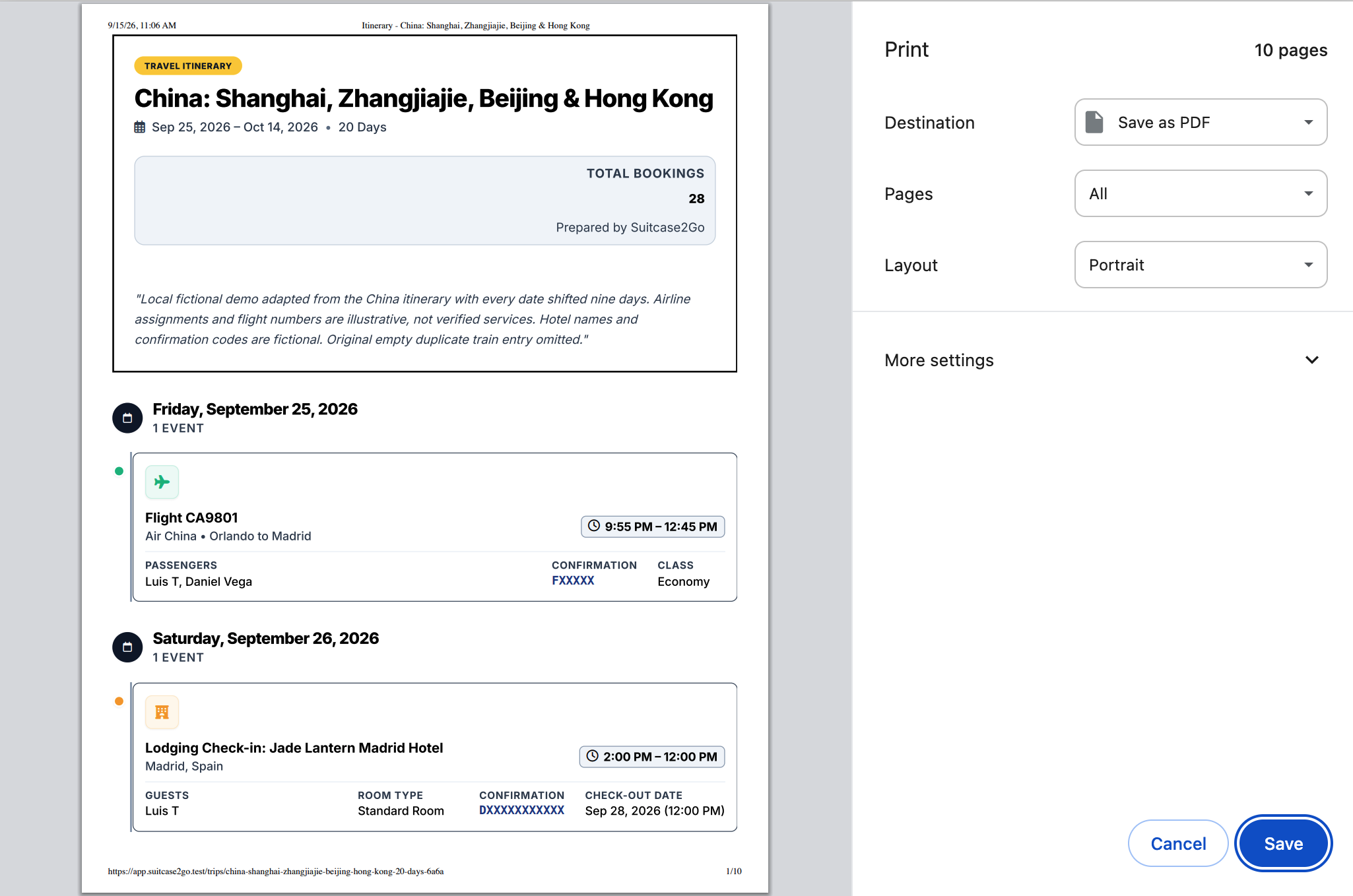
Using Suitcase2Go, you can keep flights, rental car bookings, and day-by-day itinerary plans structured alongside attached confirmation documents. The platform's trip menu includes tools to edit your schedule, share your plans with travel companions via email, and print your itinerary directly through your browser's print dialog so you always have an offline hard copy or PDF handy on remote mountain roads.