
Driving across Eastern Canada’s Maritime provinces offers dramatic coastal scenery, distinct cultural heritage, and varied topography. Pairing mainland Nova Scotia, Cape Breton Island, and Prince Edward Island within an eight-day window requires deliberate route planning. Because water crossings separate the provinces, coordinating driving distances, ferry timetables, and bridge transit corridors is vital to building an efficient schedule.
This eight-day route begins and ends at Halifax Stanfield International Airport (YHZ), following a clockwise loop that links the rugged highlands of Cape Breton to the pastoral shores of Prince Edward Island before concluding on Nova Scotia’s historic South Shore.

Route Logistics: Navigating Maritime Crossings
Connecting mainland Nova Scotia with Prince Edward Island involves two major water routes, each with distinct operations, fee schedules, and transit considerations:
- The Northumberland Ferry: Operating seasonally between Caribou, Nova Scotia, and Wood Islands, Prince Edward Island, Northumberland Ferries offers an approximately 75-minute crossing across the Northumberland Strait. Under federal rate subsidies, passenger vehicle fares begin at $45.50 CAD. Vehicles must check in at the terminal at least 40 minutes prior to departure, and advanced reservations are strongly encouraged during summer and early autumn.
- The Confederation Bridge: Spanning 12.9 kilometers across the Abegweit Passage, the Confederation Bridge connects Borden-Carleton, Prince Edward Island, to Cape Jourimain, New Brunswick. Tolls are collected only when departing PEI. Two-axle passenger vehicles pay a subsidized round-trip toll of $20.00 CAD at the Borden-Carleton toll plaza (payable by cash, credit card, or debit card). Because the bridge leads into New Brunswick, returning to mainland Nova Scotia requires driving southeast along New Brunswick Route 16 and the Trans-Canada Highway (Nova Scotia Highway 104), adding roughly 2.5 to 3 hours of highway driving back toward Halifax.
Seasonality Note: Northumberland Ferries operates from May through late November or early December depending on ice conditions. If you travel outside this seasonal window, you must enter and exit Prince Edward Island exclusively via the Confederation Bridge.
Day 1: Arrive in Halifax and Explore the Historic Waterfront
Morning & Midday
Arrive at Halifax Stanfield International Airport, pick up your rental car, and make the 35-minute drive south along Highway 102 into downtown Halifax. Check into your hotel in the downtown core or near the historic properties along the waterfront. Take the early afternoon to adjust and stretch your legs along the Halifax Waterfront Boardwalk, a continuous 4.4-kilometer pedestrian walkway flanked by active harbor slips, maritime artisan shops, and heritage docks.
Afternoon
Walk uphill to the Halifax Citadel National Historic Site. Sitting high above the downtown district, this star-shaped fortress provides sweeping views of Halifax Harbour. Adult admission is $22.00 CAD during the core May-to-November operational season (included with a Parks Canada Discovery Pass). Tour the interior barracks, explore the Army Museum, and observe historical military drills. Paid on-site vehicle parking is available on the perimeter grounds for $9.50 CAD.
Evening
Descend back toward Lower Water Street for fresh Atlantic seafood—such as Nova Scotia lobster rolls or pan-seared digby scallops—at a harborfront eatery. Get a restful night's sleep before embarking on the long drive north the following morning.
Day 2: Halifax to Baddeck via the Canso Causeway
Driving distance: Approx. 350 km (3.5 to 4 hours)
Morning
Depart Halifax early, traveling north on Highway 102 to Truro before joining the Trans-Canada Highway (Highway 104 East). This highway section cuts through central Nova Scotia toward Cape George and the Northumberland coast. Stop for fuel and a brief coffee break in Antigonish, a historic university town with pleasant Victorian architecture.
Afternoon
Cross the Canso Causeway onto Cape Breton Island. Follow Highway 105 along the Bras d'Or Lake—a vast inland inland sea designated as a UNESCO Biosphere Reserve. Arrive in the lakeside village of Baddeck by early afternoon. Baddeck served as the summer residence of inventor Alexander Graham Bell; visit the Alexander Graham Bell National Historic Site to inspect original hydrofoils, tetrahedral kites, and telecommunication prototypes.
Evening
Stroll along Chebucto Street overlooking Baddeck Harbour. Dine on local chowder and settle into an inn or cottage along Bras d’Or Lake, positioning yourself near the southern entry point of the Cabot Trail.
Day 3: Driving the Cabot Trail through Cape Breton Highlands
Driving distance: Approx. 220 km (4 to 5 hours driving time, excluding hikes and viewpoints)
Morning
Begin driving the Cabot Trail loop counterclockwise toward Chéticamp, a vibrant Acadian fishing community. Stop at the Cape Breton Highlands National Park Chéticamp Visitor Centre to obtain your vehicle day pass ($10.00 CAD per adult) or validate your Parks Canada Discovery Pass.
Entering the park, wind through the coastal cliffs and climb French Mountain. Your primary hike for the morning is the famous Skyline Trail, a 6.5-to-8.2-kilometer loop that follows a mountain ridge out to a dramatic wooden headland boardwalk overlooking the Gulf of St. Lawrence.
Critical Park Regulation: To protect fragile alpine ecology and resident wildlife (including black bears and moose), dogs and domestic pets are strictly prohibited on the Skyline Trail. In peak summer months, parking reservations may be required at the trailhead.

Afternoon
Continue following the Cabot Trail through Pleasant Bay and up North Mountain toward MacKenzie Mountain. Drive down along the Atlantic shoreline through Neils Harbour, stopping to view the historic active lighthouse. Plan a brief rest stop at Ingonish Beach or hike the gentle 3.8-kilometer Coastal Trail along the rugged granite shoreline.
Evening
Conclude the northern loop in the Ingonish or St. Ann’s area. Enjoy an evening meal featuring local oysters and Cape Breton craft beer, then rest after a demanding day of mountainous coastal driving.
Day 4: Cape Breton to Prince Edward Island via Caribou Ferry
Driving distance: Approx. 210 km driving + 75-minute ferry crossing
Morning
Depart eastern Cape Breton via Highway 105 South, crossing back over the Canso Causeway onto mainland Nova Scotia. Head west along Highway 104 toward New Glasgow, branching north onto Route 106 directly to the Caribou Ferry Terminal.
Afternoon
Arrive at the Caribou terminal at least 40 minutes before your scheduled Northumberland Ferries departure. Drive aboard the vessel, leave your vehicle, and spend the 75-minute crossing on the open passenger deck observing sea birds, fishing vessels, and red sandstone shorelines across the Northumberland Strait.
Disembark at Wood Islands, Prince Edward Island. Take Route 1 northwest (approx. 45 minutes) into Charlottetown, PEI's provincial capital. Check into your lodging in the historic downtown core.
Evening
Explore Charlottetown’s Victoria Row, a pedestrian-only cobblestone block lined with Victorian architecture, outdoor terraces, and local boutiques. Walk past Province House National Historic Site—celebrated as the birthplace of Canadian Confederation—before enjoying dinner at a local farm-to-table bistro.
Day 5: Cavendish, Anne of Green Gables, and PEI National Park
Driving distance: Approx. 80 km round-trip
Morning
Drive 35 minutes north from Charlottetown along Route 2 and Route 6 to Cavendish. Spend the morning at Green Gables Heritage Place, the historical farmstead that inspired L.M. Montgomery’s classic novel Anne of Green Gables. Tour the furnished 19th-century farmhouse, stroll through the Haunted Wood, and walk down Lover’s Lane. Adult admission is $10.00 CAD during peak summer ($8.25 CAD shoulder season), and the site is covered by the Discovery Pass.
Visitor Note: The nearby ruins of Montgomery's Cavendish home are privately owned and require separate admission; they are not part of the federal park system.
Afternoon
Head directly to the Cavendish or Brackley Beach sectors of Prince Edward Island National Park. Marvel at the contrast between the deep rust-red sandstone cliffs, pale rolling sand dunes, and the blue waters of the Gulf of St. Lawrence. Walk the boardwalk trails at Greenwich (a 30-minute drive east) if you prefer quiet trails over bustling beach areas.
Evening
Drive through the working harbor of North Rustico, often called the "Rustico Wharf." Watch local fishing boats dock with the daily catch and pick up fresh Atlantic lobster or Malpeque oysters for dinner. Return to Charlottetown for the night.
Day 6: Confederation Bridge to the Bay of Fundy
Driving distance: Approx. 260 km (3 to 3.5 hours)
Morning
Depart Charlottetown traveling west along the Trans-Canada Highway (PEI Route 1) toward Borden-Carleton. Before reaching the bridge, stop at Gateway Village for sweeping views of the 12.9-kilometer engineering marvel. Pass through the Confederation Bridge toll plaza, pay your $20.00 CAD departure toll, and cross the Abegweit Passage into New Brunswick.
Afternoon
Once in New Brunswick, follow NB Route 16 South across the provincial border back into Nova Scotia near Amherst. Continue south along Highway 104 and Highway 2 toward the Minas Basin and the Bay of Fundy, famous for having the highest recorded tides in the world.
Stop at the Joggins Fossil Cliffs UNESCO World Heritage Site or take Route 2 to Parrsboro. Walk the shores of the Minas Basin during low tide to observe the sheer vertical reach of the seabed exposed by retreating waters.
Evening
Spend the night in Truro or Parrsboro. Dine at a local country inn and enjoy an early evening along the Fundy tidal rivers, where you may spot the tidal bore advancing upstream against the current.
Day 7: Nova Scotia’s South Shore: Peggy’s Cove and Lunenburg
Driving distance: Approx. 230 km (2.5 to 3 hours)
Morning
From Truro, drive south toward the South Shore via Halifax, picking up Highway 103 West and coastal Route 333 out to Peggy’s Cove. Arrive mid-morning to explore the granite ledges surrounding the Peggy's Point Lighthouse.
Safety Precaution: Observe all posted safety signs and avoid wet, dark rocks. Rogue waves along the open Atlantic coast are frequent, powerful, and dangerous.
Afternoon
Continue along the South Shore through Mahone Bay, known for its picturesque three waterfront church steeples, and arrive in the historic town of Lunenburg. Lunenburg is an exceptionally preserved UNESCO World Heritage site featuring vibrant 18th- and 19th-century timber architecture. Walk along the waterfront, visit the Fisheries Museum of the Atlantic, and take in the craftsmanship of the traditional fishing schooners docked along Montague Street.
Evening
Enjoy fresh maritime chowder or Solomon Gundy (pickled herring) at a waterfront pub in Lunenburg. Settle into a local heritage bed and breakfast.
Day 8: Mahone Bay to Halifax & Return Departure
Driving distance: Approx. 110 km (1.25 hours)
Morning
Take a quiet morning stroll through Lunenburg's upper streets to admire the preserved "Lunenburg Bump" dormer architectural style. Check out of your accommodation and take Route 3 back toward Mahone Bay for artisan pastries and locally roasted coffee.
Afternoon
Drive northeast along Highway 103 directly toward Halifax Stanfield International Airport. If your flight departs later in the evening, use the remaining afternoon hours to visit the Halifax Public Gardens in downtown Halifax or stroll through the historic Victorian parklands. Return your rental car at the airport terminal and check in for your departure flight.
Keeping Multi-Province Bookings Organized
A road trip spanning Nova Scotia, Cape Breton, and Prince Edward Island involves multiple moving parts: scheduled ferry vehicle reservations, national park parking passes, bridge transit routes, and nightly accommodations in different towns. A simple change in maritime weather can force ferry cancellations, requiring you to adjust driving timelines quickly.
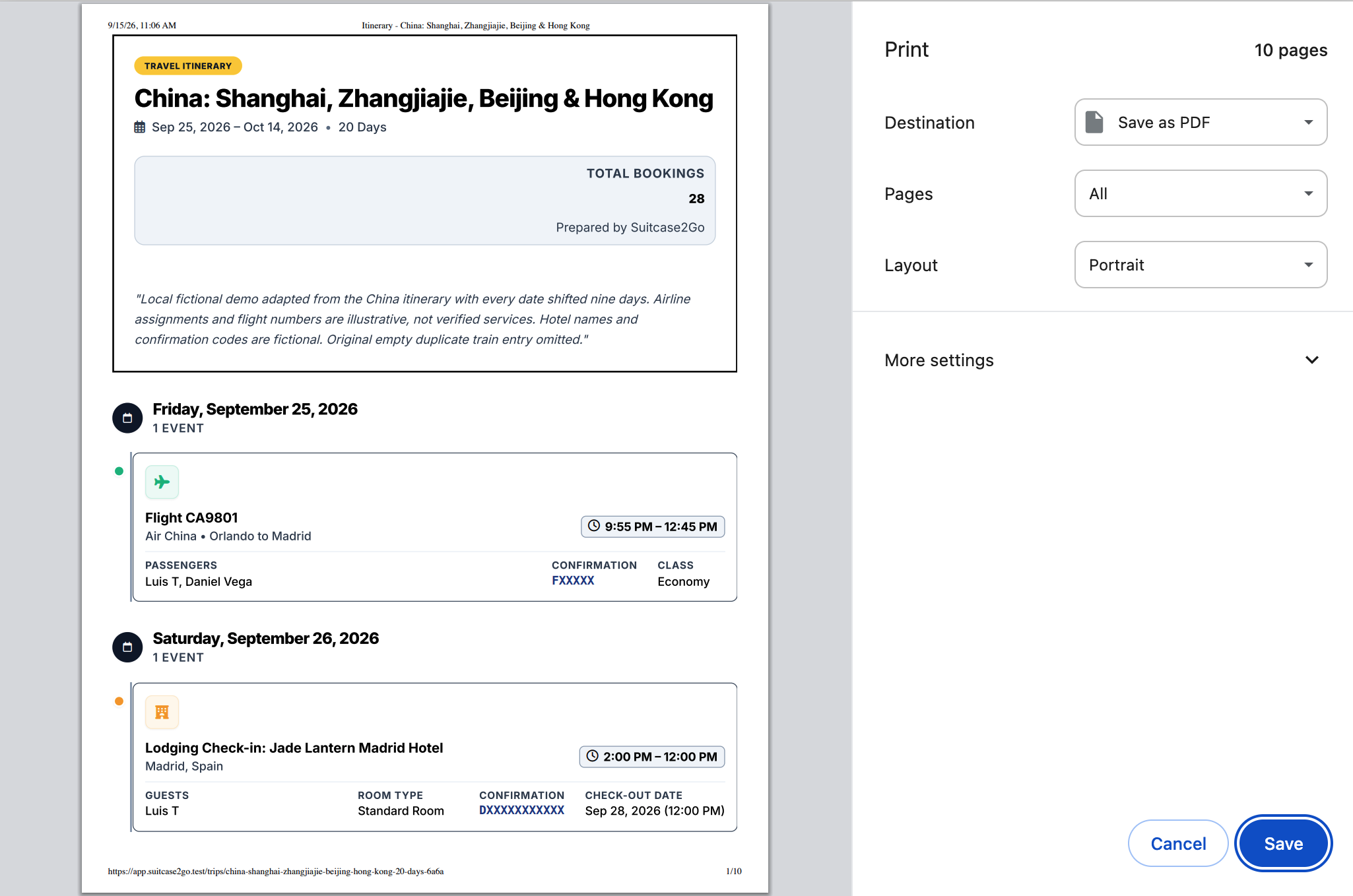
Consolidating reservations, daily schedules, and route buffers in Suitcase2Go keeps your itinerary clear and accessible. When booking rental cars or ferry spots, the Chrome extension allows you to connect your account and select Add to Trip to transfer booking details alongside your flight and stay records. You can check the generated entries against your confirmation emails, organize days using the web daily itinerary builder, and print or share trip details with travel companions before hitting the road.

Essential Maritimes Road Trip Checklist
- National Park Pass Value: If you plan to visit the Halifax Citadel ($22.00 CAD), Cape Breton Highlands ($10.00 CAD), and Green Gables ($10.00 CAD), a Parks Canada Discovery Pass ($83.50 CAD per adult, $167.50 family) provides cost savings and bypasses daily gate ticket lines.
- Ferry Reservation Buffer: Aim to book your Northumberland Ferry vehicle spot at least two to four weeks in advance during July and August. Always arrive at the Caribou terminal 40 minutes ahead of departure.
- Wildlife Caution on Cape Breton: Moose and white-tailed deer are common along Highway 105 and the Cabot Trail, particularly at dusk and dawn. Reduce speeds through unlit mountain switchbacks.
- Weather Layering: Maritime weather shifts quickly. Temperatures in coastal Ingonish or on the open waters of the Northumberland Strait can be 10°C cooler than downtown Halifax. Pack waterproof outer shells, fleece mid-layers, and sturdy hiking shoes with rubber traction for damp boardwalks and coastal granite rocks.