
Booking a journey that spans multiple airlines often solves tricky routing problems, but it introduces one of aviation's most persistent headaches: conflicting baggage allowances. A carry-on roller bag permitted on a transpacific widebody flight might exceed the strict cabin weight limit of a European regional turboprop. Meanwhile, checked luggage limits that seem generous on your departure ticket can suddenly collapse if your return connection switches operating carriers or if you booked separate tickets.
Navigating these differences requires understanding the legal frameworks that govern through-checked baggage, recognizing the vital difference between single-ticket itineraries and self-transfers, and adopting a standardized packing strategy based on your itinerary's most restrictive segment.

Single Ticket vs. Separate Tickets: The Foundational Distinction
Before evaluating weight limits or dimensions, verify how your flights were ticketed. Every baggage rule in commercial aviation hinges on whether your flights share a single contract of carriage.
+-----------------------------------------------------------------------------------+
|                             HOW YOUR FLIGHTS ARE TICKETED                         |
+-----------------------------------------+-----------------------------------------+
| SINGLE TICKET (Interline / Codeshare)   | SEPARATE TICKETS (Split / Self-Transfer)|
+-----------------------------------------+-----------------------------------------+
| * 1 master e-ticket number (13 digits)  | * 2+ independent ticket numbers         |
| * Governed by international regulations | * No legal connection between airlines  |
|   (DOT § 399.87, CTA 144-A, IATA 302)   | * Each carrier enforces standalone rules|
| * Checked bags usually transfer through | * Bags must be retrieved & re-checked   |
| * Standardized checked allowance        | * Separate baggage fee per ticket       |
+-----------------------------------------+-----------------------------------------+
Single-Ticket Bookings (Interline and Codeshare)
When two or more airlines are booked together on one reservation—identifiable by a single 13-digit e-ticket number across all segments—your checked luggage is protected by international treaty frameworks and government regulations. In most cases, your bags check through to your final destination, and an established rule harmonizes your checked baggage allowances and fee schedules.
Separate-Ticket Bookings ("Self-Transfers" or "Virtual Interlining")
If you purchased flights through separate transactions, or via an online travel agency that bundled independent tickets to lower the total fare, no regulatory umbrella protects your baggage. Each airline operates as an isolated contract. You must collect your luggage at the intermediate airport, clear local border control and customs, transit to the departures hall, check in again, pay any baggage fees required by the second carrier, and re-clear security.
Airline policies on checking bags across independent tickets have tightened significantly. For example, the American Airlines through-checked baggage policy confirms that checked bags will only be transferred to a connecting flight on a separate ticket if both flights share the exact same booking record and connect exclusively to Oneworld partner carriers. If booked under separate record locators or non-alliance airlines, American will only check luggage to the intermediate city. Similarly, United Airlines checked baggage rules specify that through-checking across separate tickets is permitted only when connecting to another United or Star Alliance flight, and even then, partner airlines on the return journey are not bound to reciprocate.
How Checked Baggage Rules Are Determined on Single Tickets
When your trip is on a single ticket, three main regulatory systems determine which airline's luggage rules apply to your checked bags.
1. United States: U.S. DOT 14 CFR § 399.87
For any single-ticket itinerary where the ultimate origin or destination is inside the United States, consumer protection rules established under 14 CFR § 399.87 dictate that the baggage allowances and fees established at the beginning of the journey apply throughout the entire itinerary.
Crucially, under DOT regulations, for codeshare flights touching the U.S., the baggage allowances and fees of the marketing carrier (the airline whose two-letter designator appears on your flight ticket, such as AA 1234 or DL 5678) take precedence over the operating carrier if their policies differ. This prevents an operating partner from imposing unexpected baggage fees halfway through an itinerary.
2. Canada: CTA Decision No. 144-A-2014
Similar to the U.S. mandate, the Canadian Transportation Agency enforces standardized allowances under the Canadian Transportation Agency interline baggage framework. On single-ticket itineraries to or from Canada involving multiple airlines, a single set of baggage rules applies from departure to destination. The carrier listed on the first flight coupon selects whether to apply its own baggage rules or defer to the international IATA standard, and those chosen terms must be disclosed directly on your e-ticket summary.
3. Rest of the World: IATA Resolution 302
For international itineraries that do not touch the United States or Canada, airlines resolve differing baggage provisions using the 4-step framework set out by the International Air Transport Association (IATA). As detailed in All Nippon Airways' codeshare and IATA Resolution 302 guidance, the rules are selected in order:
- Harmonized Provisions: If all participating carriers have identical allowances, those provisions apply.
- Most Significant Carrier (MSC): If provisions differ, the published rules of the "Most Significant Carrier" apply. Geographically, the MSC is the carrier operating the flight that crosses between primary IATA Tariff Conference areas (TC1: Americas; TC2: Europe, Africa, Middle East; TC3: Asia and Oceania). If the trip does not cross conference areas, it is the carrier crossing sub-areas; if wholly within one sub-area, it is the carrier operating the first international sector.
- Accepting Carrier: If the MSC does not publish explicit baggage rules for that routing, the rules of the carrier operating the initial check-in flight apply.
- Sector-by-Sector: If no earlier rule resolves the issue, operating carrier rules apply to each flight leg individually.
The Cabin Baggage Blindspot: Operating Carrier Limits Always Rule
While government rules and IATA Resolution 302 harmonize checked baggage allowances across single tickets, carry-on and cabin baggage rules are never harmonized across airlines.
Operating airlines retain complete authority over carry-on allowances to account for aircraft physical constraints, overhead bin dimensions, and safety regulations. This dynamic creates the single most common packing trap on multi-carrier journeys:

- Mainline Segment: Flying across the Atlantic on a widebody jet, your ticket might permit an overhead cabin bag weighing up to 10 kg (22 lbs) plus a personal item.
- Regional Feeder Segment: Connecting to a turboprop or smaller regional jet operated by a domestic or regional partner, the maximum cabin weight might drop to 7 kg (15.4 lbs) or 8 kg total, with significantly smaller dimensional limits.
If your carry-on exceeds the cabin limits of the operating regional carrier, you will be forced to gate-check the bag. On regional flights with no gate-check valet service, you may face gate-handling baggage fees if your ticket does not include a checked allowance.
Step-by-Step Logistics Checklist: Planning Multi-Carrier Baggage
To prevent surprise fees or repacking at the departure gate, follow this step-by-step checklist when booking and packing for a multi-airline itinerary.
STEP 1: Verify Booking Structure (Single e-ticket vs. Split tickets)
        |
        v
STEP 2: Identify Regulatory Region (DOT § 399.87 / CTA / IATA Res 302)
        |
        v
STEP 3: Map Cabin Limits Across Every Operating Carrier
        |
        v
STEP 4: Pack to the Lowest Common Denominator
        |
        v
STEP 5: Document Allowances & Keep Gear Accessible
Step 1: Confirm Single E-Ticket vs. Independent PNRs
Check your booking confirmation email. Ensure there is one 13-digit ticket number covering every passenger from start to finish. If you have separate booking references (PNRs) from different airlines, assume your checked bags will not transfer automatically and budget connection times of at least 3 hours to collect luggage, clear customs, and re-check.
Step 2: Establish the Governing Checked Allowance
- If traveling to/from the U.S., locate the first marketing carrier on your e-ticket receipt; its checked bag fee schedule applies throughout.
- If traveling to/from Canada, review the summary on your ticket receipt to see whether the first carrier applied its own rules or the MSC rule.
- If traveling between Europe, Asia, or the Americas, identify the carrier that crosses the primary international oceanic or continental boundary (the IATA MSC).
Step 3: Audit Every Operating Carrier's Cabin Baggage Caps
Look past the airline that sold you the ticket and identify who actually operates each flight. Note the most restrictive carry-on dimensions and weight limits across every leg.
| Carrier Segment Type | Typical Overhead Size Limit | Typical Cabin Weight Limit |
|---|---|---|
| Long-haul Mainline (Widebody) | 55 x 40 x 23 cm (21.6 x 15.7 x 9 in) | 10 kg to 12 kg (or no weight limit) |
| European / Asian Regional Jet | 55 x 35 x 20 cm (21.6 x 13.7 x 7.8 in) | 7 kg to 8 kg (15.4 to 17.6 lbs) combined |
| Island Feeder / Turboprop | 48 x 34 x 20 cm (19 x 13.5 x 8 in) | 5 kg to 7 kg (11 to 15.4 lbs) max |
Step 4: Pack to the Lowest Common Denominator
Pack your carry-on bag so that its packed weight and physical dimensions conform to the smallest plane on your journey. If your second flight allows only 7 kg, your carry-on cannot weigh 10 kg leaving home, even if the long-haul carrier allows it.
Step 5: Keep Fragile Electronics and Medications Modular
Always pack laptops, lithium-ion power banks, prescription medications, passports, and keys in a compact personal item (like a small backpack or tote) that fits beneath the seat in front of you. If an operating carrier demands that your rolling bag be checked at the boarding gate due to full overhead bins or regional cabin limits, you can detach your essential items in seconds without holding up the boarding queue.
Managing Multi-Flight Logistics in Suitcase2Go
Keeping track of multiple airline confirmation codes, varying operating carriers, and separate flight documents can get overwhelming quickly.
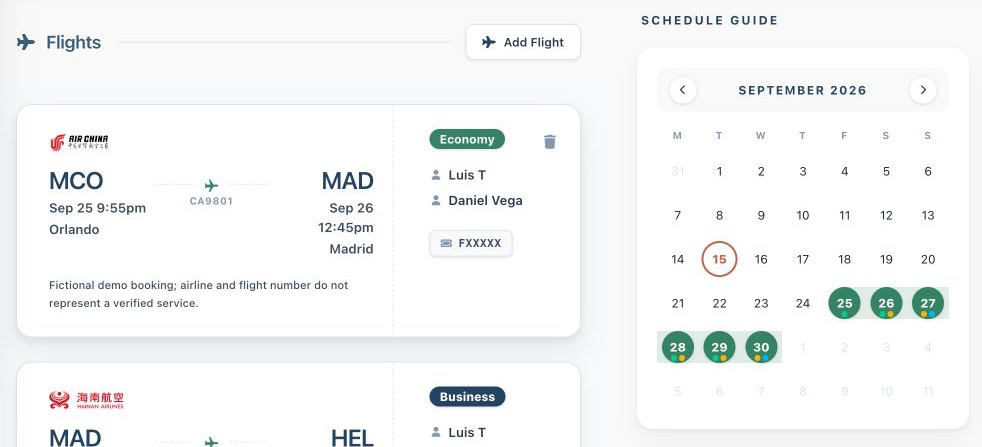
You can keep your multi-carrier travel details organized in Suitcase2Go. Use the web app's flight views to see upcoming departure times and dates side by side. When booking complex combinations, saving each carrier's confirmation code and ticket receipts under the Attachments & Emails feature provides quick access to your written e-ticket baggage allowance when standing at a transfer desk.
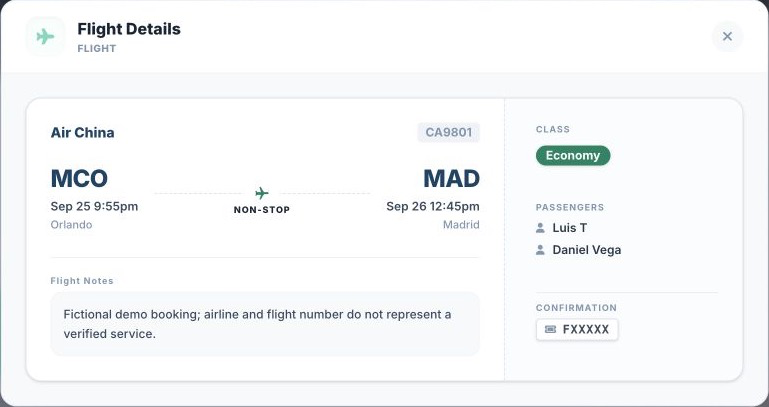
Opening the Flight Details view lets you review each individual leg's departure point, timing, and ticketed passenger list. When reviewing multi-leg flights, compare the marketing carrier and the operating airline for each leg so you can look up specific cabin dimensions well before you head to the airport.
The Manual Alternative: The Spreadsheet Matrix
If you prefer managing your trip details manually without digital travel tools, build a simple spreadsheet before packing. Set up columns for:
- Flight Segment & Date
- Operating Airline (e.g., Regional Express, not just the codeshare partner)
- Aircraft Model (e.g., Boeing 787 vs. ATR 72)
- Cabin Weight & Dimension Maximums
- Checked Bag Allowance Included with Fare
- Minimum Connection Transfer Time
Filling out this matrix highlights where your allowances drop. If segment three has a 7 kg carry-on limit while segments one and two permit 10 kg, highlight that row in red and pack your primary bag to weigh no more than 6.8 kg before departing your living room.
Final Checklist Before Departure
- Inspect your e-ticket receipt: Ensure the baggage allowance is explicitly printed on the document. Print or save a PDF copy to your phone to resolve check-in desk discrepancies.
- Weigh your packed bags with a digital luggage scale: Test both your checked suitcase and your rolling carry-on with personal items loaded.
- Review status and co-branded credit card perks: Remember that airline credit card free checked bag perks almost never apply when checking in with a foreign partner airline.
- Verify transfer responsibility: If traveling on separate tickets, confirm that you have sufficient transit time (minimum 2.5 to 3 hours international) to retrieve your luggage from the carousel, clear customs, and check in at the onward carrier's counter before their bag-drop cutoff.