
Booking lodging often feels deceptively simple: pick dates, select a room, and enter payment details. Yet some of the costliest travel friction happens after the confirmation email arrives. A traveler lands on a late red-eye only to find the front desk closed at 10:00 p.m. Another discovers a vacation rental requires hauling domestic trash off-site despite charging a hefty cleaning fee, or that mandatory resort fees must be settled locally at check-in.
Catching these constraints after you submit a non-refundable deposit leaves little leverage. By running a methodical pre-booking audit across four core areas—arrival timing, amenity definitions, house rules, and fee structures—you can protect your budget and trip schedule before binding contracts take effect.

Step 1: Audit Arrival Access and Late-Arrival Deadlines
Never assume a confirmed reservation guarantees a room will wait for you indefinitely. Properties operate under vastly different arrival policies depending on whether they are managed hotels or independent vacation rentals.
Hotel Late Arrivals: Mind the 6:00 A.M. Cutoff
At major chain hotels, a reservation guaranteed with a credit card generally holds the room through the night, but policies have precise limits. For example, Marriott's late arrival guidelines specify that guaranteed rooms are held until 6:00 a.m. local property time the morning after your scheduled arrival date. If your flight is delayed past midnight and you arrive after 6:00 a.m. without notifying the hotel, the reservation can be canceled as a no-show, triggering penalty fees and releasing the room to other guests.
- Audit Action: If your transit itinerary puts you at the property after 10:00 p.m., inspect the property's front-desk operating hours. For unstaffed boutique properties or rural inns, verify whether self-check-in is available or if late arrivals incur a fee.
- Early Check-In Reality: Do not count on standard early check-in requests. Under Marriott's official early check-in policy, early arrivals are strictly subject to room availability on the day of check-in and are never guaranteed. If you land on a morning international flight and require guaranteed immediate room access, the only reliable policy standard across major brands is reserving the room for the preceding night.
Vacation Rentals: Arrival Cutoffs and Lockbox Protocols
Vacation rentals present different logistics. Peer-to-peer platforms do not release keypad combinations or lockbox credentials at the time of booking. Platforms safeguard security by delivering access codes closer to arrival. For instance, Vrbo's host communication policy establishes that hosts must supply entry instructions at least 72 hours before arrival for bookings made 5 or more days ahead, or within 12 hours for last-minute reservations.
- Audit Action: Before booking, inspect the listing's check-in window (such as 3:00 p.m. to 8:00 p.m.). If the listing requires an in-person key handoff and you anticipate arriving past the cutoff, message the host prior to booking to confirm they can accommodate late entry.
Step 2: Verify Amenity Language and Feature Limitations
Listing filters frequently mask critical details. An amenity badge for "air conditioning" or "parking" on a search aggregator does not guarantee the feature covers your specific unit or travel party.
Key Amenities to Scrutinize
- Climate Control: In older European or historic downtown properties, "air conditioning" often denotes a portable fan, an evaporative cooler, or central building cooling that is seasonally deactivated during shoulder months. Check the written description for central HVAC vs. room units.
- Parking Constraints: Verify whether parking is on-site, off-site, complimentary, or billed separately. Look for height restrictions if driving an SUV or rental van.
- Elevators vs. Stairs: In walk-up buildings, search the listing text for elevator access, especially when traveling with heavy baggage, strollers, or travelers with mobility restrictions.
- Workstations and Internet: If remote work is necessary, audit whether the listing promises dedicated desk space with ergonomic seating or merely a dining table, and look for verified download speeds in the listing description.
On comprehensive booking portals, scan the dedicated "House rules" and "The fine print" sections on the property page before payment, as outlined in Booking.com's customer service terms. These sections disclose elevator limitations, construction notices, or deposits that do not appear in the top-line summary.
Step 3: Audit House Rules and Chore Expectations
Short-term rental platforms have instituted clearer standards for guest obligations, but checking these constraints before booking remains essential.
Under Airbnb's reasonable house rules policy, all property-specific rules must be disclosed on the listing page prior to booking. Hosts cannot introduce unexpected rules later through private messaging, signs posted on walls, or arrival handbooks. Furthermore, platform rules prohibit hosts from demanding unreasonable checkout chores—such as stripping beds, washing guest linens, or hauling rubbish off-site—if a cleaning fee is already charged.

The Pre-Booking House Rule Checklist
- Age Minimums: Platforms like Vrbo standardise house rules around core criteria, including renter minimum age (often 21 or 25). Verify that the primary booker meets this requirement.
- Quiet Hours and Occupancy Caps: Audit local noise restrictions and maximum visitor limits. Even quiet daytime visitors may violate strict single-party occupancy rules.
- Third-Party Rental Agreements: If a host requires you to sign a separate legal contract or provide external identity verification, Airbnb policy requires that this requirement and its specific terms be disclosed on the listing page before you reserve.
Step 4: Calculate Total Pricing and Mandatory Local Fees
Quoted room rates can diverge sharply from final checkout totals if mandatory fees are obscured. Regulatory changes have strengthened upfront transparency, but travelers still need to know what must be paid online versus at the property desk.
Under the FTC rule on unfair or deceptive fees (codified at 16 CFR Part 464), lodging providers and booking platforms serving U.S. consumers must display the upfront Total Price in initial pricing displays. This total must incorporate all mandatory charges known in advance, including mandatory resort fees, cleaning fees, and destination charges. Only government-imposed taxes and genuine optional add-ons may be excluded from the initial total.

However, international stays and localized hotel operations carry specific payment rules:
- On-Site Fee Settlement: Hotel destination and resort fees are frequently billed locally upon arrival or departure, typically in local currency. If you redeem hotel loyalty points for a room award, note that mandatory resort fees are generally not covered by points and must be paid out-of-pocket directly to the hotel.
- Incidental Holds: Always check the property fine print for incidental hold requirements. Hotels routinely freeze $50 to $150 per night on your credit card for incidentals, which ties up available credit limits during multi-stop trips.
Pre-Booking Audit Workflow: Step-by-Step
Before entering your credit card details, follow this systematic four-step verification:
| Audit Step | What to Inspect | Red Flag / Limitation |
|---|---|---|
| 1. Arrival Window | Check-in cutoffs, 24/7 desk staffing, or keybox policies. | Check-in ends at 8:00 p.m. with an unstaffed front desk when your flight lands at 7:30 p.m. |
| 2. Mandatory Fees | Upfront Total Price vs. on-site destination fees and deposit holds. | Undisclosed local resort fees or steep cash security deposits required at arrival. |
| 3. House Rules | Minimum renter age, pet policies, visitor bans, checkout chores. | Requirements to wash linens or vacuum despite paying a full cleaning fee. |
| 4. Core Amenities | Specific unit heating/cooling, on-site dedicated parking, elevator access. | A multi-story walk-up mislabeled as fully accessible or lacking working A/C in summer. |
Organizing Lodging Confirmations for Your Trip
Once you have audited and confirmed your reservations, keeping arrival details organized avoids confusion on travel day. Stashing confirmation numbers, front-desk operating hours, and entry procedures across scattered email threads increases the risk of missed check-in cutoffs.
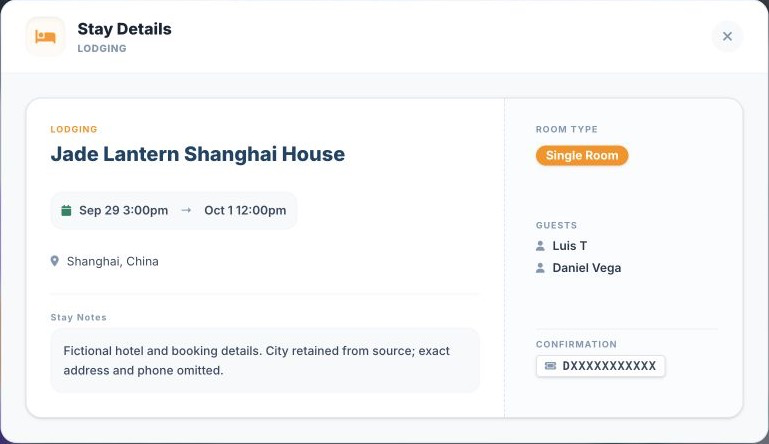
Using a dedicated itinerary workspace like Suitcase2Go allows you to keep flight schedules, lodging bookings, and daily plans together in one clear view. By assembling your confirmed check-in windows alongside flight arrival times, you can quickly spot tight connection buffers, schedule late-arrival notifications with hotel desks well before departure, and ensure your entire travel party stays aligned.