
Every group trip risks the same logistical mismatch: four travelers arrive at a shared rental house with four portable Bluetooth speakers, three bulky corkscrews, and four hair dryers, yet nobody packed a universal adapter, a first-aid kit, or coffee filters.
Packing redundancy does not just clutter your accommodation. It inflates luggage weights, triggers avoidable airline baggage fees, and crowds car trunks. When each participant packs in isolation, individuals default to worst-case assumptions, packing common household and recreational supplies that should be shared.

Coordinating a shared packing workflow eliminates this overlap. By dividing equipment into personal versus communal tiers, assigning clear ownership, and verifying destination amenities ahead of departure, your group can travel lighter, avoid regulatory luggage bottlenecks, and keep group gear accountable.
Step 1: Separate Individual Necessities from Communal Gear
Before opening a spreadsheet or note-sharing app, establish clear boundary rules between what each individual must pack for themselves and what should be consolidated into single shared units.

A proven standard for dividing gear originates in outdoor risk management. The National Park Service Ten Essentials framework outlines life-safety systems (navigation, hydration, insulation, illumination, first aid, fire, repair tools, nutrition, sun protection, and emergency shelter). While critical survival gear requires personal redundancy, support equipment can be distributed.
The Gear Separation Matrix
-
Strictly Individual (Never Consolidate):
- Prescriptions and specialized personal medications.
- Base layers, technical clothing, walking shoes, and weather-rated jackets.
- Personal hydration bottles or bladders.
- Identification, passports, boarding passes, and payment cards.
- Baseline personal illumination, such as a compact headlamp or pocket flashlight.
-
Shared Communal Gear (Assign One to Two per Group):
- High-capacity multi-port USB-C wall chargers and international outlet adapters.
- Group first-aid and medical kits (blister care, trauma basics, over-the-counter pain relievers, digestive aids).
- Specialty lifestyle gear: Bluetooth speakers, card decks, portable steamers, laundry detergent sheets, or beach shade tents.
- Shared outdoor hardware: camp stoves, water filtration systems, group cookware, and gear repair kits.
-
Destination-Sourced Items (Do Not Pack):
- Bulky consumables that can be purchased in minutes upon arrival, such as full-size sunscreen bottles, insect repellent, charcoal, or camp stove fuel.
Step 2: Account for Airline and Transport Regulations
When assigning shared equipment to specific travelers, transport rules dictate who can carry what. Overlooking hazardous materials regulations can delay your entire party at airport security or result in confiscated gear.
Lithium Batteries and Power Banks
If your group designates one traveler to carry a multi-device charging hub or heavy-duty external battery pack, verify airline battery limits. Under FAA PackSafe lithium battery guidelines, spare lithium-ion batteries and portable power banks are strictly prohibited in checked baggage and must be packed in carry-on bags.
Power banks rated up to 100 watt-hours (Wh) are permitted in carry-on luggage without prior airline approval. Larger batteries between 101 and 160 Wh require airline authorization and are capped at two spares per passenger, while batteries over 160 Wh are forbidden on commercial passenger aircraft. If a traveler is asked to gate-check their carry-on roller bag due to limited overhead bin space, all power banks must be immediately removed and carried into the cabin.

Stoves, Cookware, and Fuels
For outdoor group excursions, stove distribution requires strict compliance. The Transportation Security Administration camp stove rules permit camp stoves in both carry-on and checked luggage only if they are entirely drained of fuel and thoroughly cleaned so no lingering fuel vapors remain. Liquid fuel bottles, propane canisters, and butane containers cannot be flown in any baggage and must be assigned as an on-the-ground purchase at your destination.
Step 3: Choose and Configure Your Shared Tracking Tool
Avoid planning group gear through unstructured messaging threads or chat groups. Within days, confirmed assignments get buried beneath casual conversation, leading to duplicate packing or forgotten essentials. Instead, use a centralized, real-time collaboration tool.
Option A: Tabular Tracking with Checkboxes
For trips involving more than four people or technical gear lists, a cloud spreadsheet provides structured filtering and clear accountability. Using Google Docs Editors interactive checkboxes, you can insert native checkbox cells that toggle between status values, allowing participants to filter items by assigned carrier, status, or packing category.
Set up your master sheet with five core columns:
- Item Name & Description: Specific make, model, or capacity (e.g., "Anker 4-port 65W USB-C Charger").
- Category: Electronics, First Aid, Kitchen/Pantry, Entertainment, or Outdoor Logistics.
- Assigned Owner: The specific traveler responsible for packing and bringing the item.
- Transport Bag: Carry-On, Personal Item, or Checked Bag (critical for hazardous items or weight limits).
- Packed Confirmation: Interactive checkbox checked only when the item is physically inside the bag.
Option B: Mobile-Native Shared Checklists
For weekend getaways or smaller parties, lightweight mobile collaboration works well. You can use Apple Support shared notes collaboration to generate real-time checklist notes shared across iCloud users. Participants can view updates instantly, check off items as they pack, and add parenthetical tags indicating who is carrying each communal item.
Worked Example: A Fictional 4-Person Cabin Trip Packing Matrix
To illustrate how communal distribution functions in practice, consider a fictional four-person weekend trip to an off-grid mountain rental by four travelers: Alex, Jordan, Taylor, and Morgan.
| Item Description | Category | Assigned Carrier | Transport Type | Packed? |
|---|---|---|---|---|
| 100W 4-Port USB-C Desktop Charger | Electronics | Alex | Carry-On | [ ] |
| Group First Aid & Wilderness Blister Kit | Safety | Jordan | Checked | [ ] |
| Cleaned Camping Stove (No Fuel) | Camp/Kitchen | Taylor | Checked | [ ] |
| Multi-Tool & Duct Tape Repair Roll | Maintenance | Taylor | Checked | [ ] |
| Portable Bluetooth Speaker | Recreation | Morgan | Carry-On | [ ] |
| French Press & Local Coffee Beans | Kitchen | Alex | Checked | [ ] |
| 20,000 mAh (74 Wh) Power Bank | Electronics | Morgan | Carry-On | [ ] |
| Fuel Canister & Firewood | Consumables | Buy upon arrival | N/A | [ ] |
In this model, only one multi-port charger and one speaker travel with the group. Instead of four separate people carrying heavy, half-empty first aid boxes, Jordan manages an expanded kit that serves all four travelers, freeing up space in the others' bags.
Step 4: Audit Accommodation Amenities and Trip Itineraries
Before finalizing assignments, verify what your accommodation already supplies. Vacation rentals, boutique hotels, and campgrounds often maintain inventories that make packing specific tools unnecessary.
- Audit Kitchen and Bathroom Defaults: Contact your host or check the listing specifications. Most modern vacation rentals supply hair dryers, irons, drip coffee makers, basic cookware, and salt and pepper. Do not assign someone to pack an appliance unless you have confirmed its absence.
- Align Packing with the Master Itinerary: Gear requirements should mirror scheduled daily activities. If you are scheduling a boating afternoon, a mountain hike, and a formal dinner, map communal items directly to those calendar blocks.
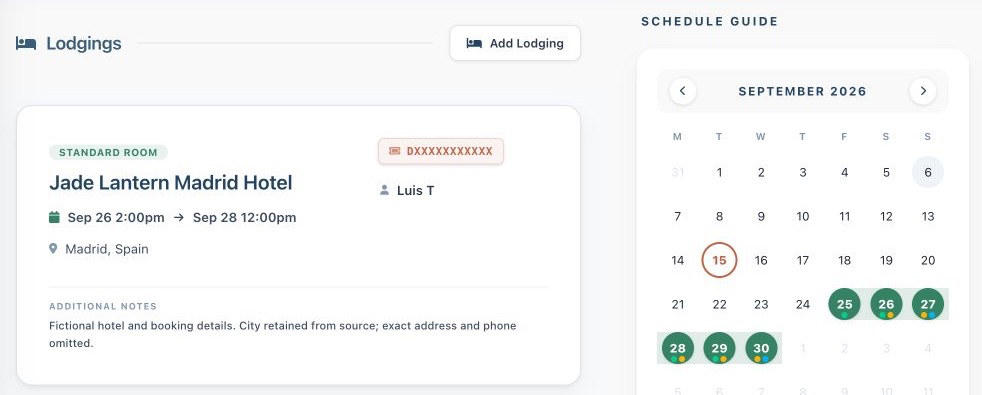
Keeping flights, rental reservations, and daily plans accessible to all travelers helps the group cross-reference logistics against packing deadlines. You can coordinate your schedule using Suitcase2Go, which lets you organize flights, stays, and daily plans in one structured space. From the Web trip menu, you can use the Share feature to invite travel companions via email with specific view or edit permissions, helping everyone verify lodging amenities and scheduled activities before packing.
Step 5: Execute the 48-Hour Cross-Check
Two days before departure, hold a brief virtual check-in or send a status ping across your tracking document:
- Identify Unassigned Items: Scan the spreadsheet for items with a blank "Assigned Owner" field. Either assign them immediately or consciously agree to leave them behind.
- Audit Weight Distribution: Ensure one traveler is not absorbing all heavy communal items. If Taylor is carrying the camp stove and repair tools in a checked bag, Alex or Jordan should absorb the bulkier, lighter items like beach towels or extra pantry supplies.
- Confirm Destination Purchases: Designate who is stopping at the destination grocery or outfitter store to pick up restricted items (such as fuel canisters, bear spray, or oversized liquids) before heading to your accommodation.
By systematizing your group packing with clear categories, assigned owners, and verified travel constraints, your group can eliminate redundant weight, stay fully compliant with airline safety rules, and ensure nothing essential gets left behind.