
Traveling with a group often starts with shared excitement, but rigid schedules quickly lead to friction. When five or six adults attempt to move across a city as a single unit for sixteen continuous hours, decision fatigue sets in. Fast walkers grow impatient in museum gift shops, slow morning risers feel perpetually rushed, and meal choices become prolonged committee debates.
The most resilient group itineraries do not force constant togetherness. Instead, they rely on intentional, scheduled independent exploration windows. Structuring predictable personal time allows early risers to photograph quiet morning plazas while night owls sleep in, gives solo shoppers freedom to browse without guilt, and prevents the collective irritability that ruins group dynamics.

Establishing these windows requires clear logistical parameters. Without deliberate boundaries, an uncoordinated "free afternoon" can turn into an endless stream of missing-traveler group texts and delayed dinner reservations. This guide outlines an operational workflow to establish daily solo windows, verify meeting contingencies, and keep your group organized.
The "Anchor-and-Scatter" Framework
Independent time works best when framed around an operational model known as the Anchor-and-Scatter framework.
Rather than scheduling every hour of the day, an organizer establishes two or three mandatory group "Anchors." These are fixed-time, fixed-location commitments that require everyone’s presence, such as a prepaid private museum tour, a train departure, or a booked dinner. The time between these anchors represents the "Scatter" phase—an independent window where individuals or pairs split off to pursue their own interests.

08:30 AM - Breakfast & Daily Briefing (Anchor)
10:00 AM - Group Historic Site Tour (Anchor)
12:30 PM - Scatter Phase (Independent Exploration & Lunch)
04:30 PM - Reconvene at Designated Physical Landmark (Anchor)
07:00 PM - Group Dinner or Optional Evening Scatter
For a scatter phase to function smoothly, every traveler must agree to three ground rules before dispersing:
- The Reconvene Time Is Non-Negotiable: The designated meeting time is when travelers stand at the meetup point, not when they begin walking toward it.
- No Group Decisions During Scatter Time: Travelers must not text the main group to ask where everyone is having lunch. Scatter time is strictly self-directed.
- Independent Financial Responsibility: Any transport, tickets, or meals purchased during scatter windows are handled by the individual, keeping group expense logs uncluttered.
Step-by-Step Implementation Workflow
Step 1: Establish Daily Cadence During Pre-Trip Planning
Negotiate the schedule before departure rather than during the trip. In your pre-trip briefing, designate the standard window length. For dense, walkable cities, a three-to-four-hour afternoon window offers sufficient time to explore an art gallery, sit at a café, or return to lodging for a rest without stranding travelers far away.
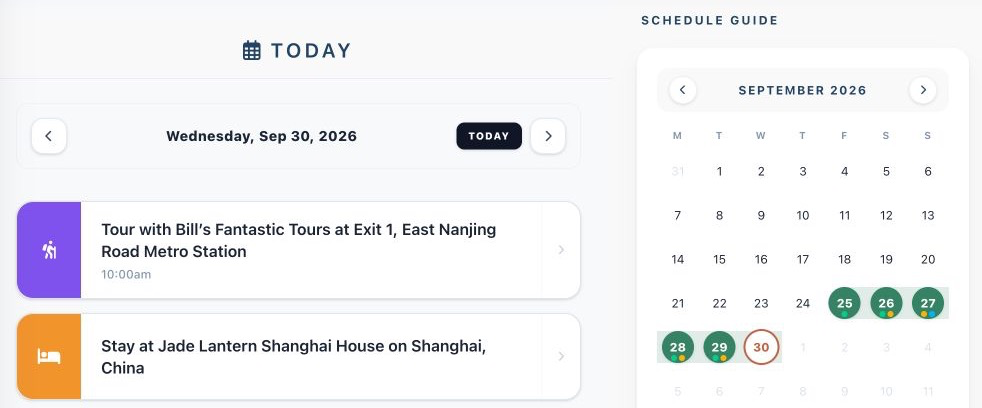
Create a master itinerary that visually marks shared anchors versus personal exploration blocks. Centralized itinerary platforms like Suitcase2Go let trip organizers assemble daily plans with scheduled flights, stays, and day-by-day segments, ensuring the entire traveling party has an updated record of the day’s timeline.
Step 2: Define Exact Physical Reconvene Pins
Never designate a vague meeting point like "the train station" or "the cathedral." Major transit hubs and historic monuments often span multiple city blocks with dozens of exits.
Instead, define a hyper-specific, publicly identifiable physical pin:
- Poor Pin: "Meet outside Milan Central Station at 5:00 PM."
- Operational Pin: "Meet beside the ground-level pharmacy inside Milan Central Station, directly across from Track 14, at 4:45 PM for our 5:05 PM train."
Require travelers to save the exact pin in their navigation apps before departing the morning anchor.
Step 3: Configure Safety and Location Check-Ins
Independent exploration must never turn into a safety liability. Ensure that travelers can signal their status without intruding on each other’s personal time.
Real-Time Tracking for Large or Mixed-Age Groups
If your party includes first-time international travelers or teenagers, establish real-time location sharing before splitting up:
- Cross-Platform Option: Inside messaging groups, participants can share dynamic updates. According to WhatsApp Help Center's Live Location Guide, users can share their live, end-to-end encrypted location directly in group or individual chats for fixed windows of 15 minutes, 1 hour, or 8 hours.
- Google Maps Sharing: Travelers can broadcast their location continuously or for specific durations directly inside Google Maps. The Google Maps Location Sharing Support Guide explains how travelers can share real-time GPS coordinates, device battery levels, and transit status with designated contacts.
Passive Automation for iOS Groups
For groups where members carry iPhones running modern software, Apple's native messaging offers passive verification. Under Apple Support: Use Check In on iPhone, travelers can initiate a Check In within an Apple Messages thread using either "When I Arrive" (tracking route progress to the agreed reconvene pin) or "After a timer." If an explorer stops moving or fails to dismiss the prompt within the set window, Apple securely notifies the recipient with the traveler’s last recorded location, battery level, and cellular signal status.
Step 4: Prepare for Local Connectivity Failures
Independent travelers frequently run out of battery or enter subway stations and historic masonry buildings that block cellular signals. Avoid planning protocols that depend exclusively on live internet connections.
Before splitting up, ensure each traveler prepares two essential offline fallbacks:
- A Paper or Saved Digital Screenshot Card: Every traveler must carry the hotel's physical business card or an offline digital note displaying the lodging's local-language address and emergency phone contact.
- Verified Offline Navigation: While many travelers rely on Google Maps, note critical technical constraints. As detailed in the Google Maps Offline Maps Support Guide, downloaded offline map areas only support driving routes; walking and public transit directions are completely unavailable without an active data connection. If your group is exploring pedestrian zones without international data roaming, equip everyone with an offline map tool that natively supports downloaded pedestrian navigation, or ensure Apple Maps offline walking areas are saved on iOS devices.
Worked Planning Example: Six Travelers in Florence
To see how this framework functions in practice, review this fictional scenario for a group of six friends visiting Florence, Italy.
- Morning Anchor (09:00 AM – 11:30 AM): The entire party meets at the Accademia Gallery for a pre-booked entrance. They tour the museum together.
- The Transition (11:30 AM – 11:45 AM): The group exits the museum and gathers briefly on the Piazza San Marco. The trip organizer confirms the evening anchor: Reconvene at 4:30 PM at the bronze Porcellino Fountain at Mercato del Porcellino (Piazza del Mercato Nuovo). The organizer drops a digital pin into the group chat.
- Independent Scatter Window (11:45 AM – 4:30 PM):
- Subgroup A (Two food lovers): Book a seated three-course lunch at a trattoria across the river in Oltrarno and visit artisan leather workshops.
- Subgroup B (Two endurance walkers): Grab quick paninis and climb the 414 steps of Giotto’s Campanile before browsing vintage boutiques.
- Subgroup C (Two tired travelers): Eat gelato, sit in the Boboli Gardens, and head back to the hotel for a two-hour rest and phone recharge.
- The Regroup (4:30 PM): All six travelers assemble at the Porcellino fountain. Because everyone pursued their preferred balance of rest and activity, the group gathers energized and ready for their shared 5:00 PM sunset walk up to Piazzale Michelangelo.
[ Morning Group Anchor ] -> [ 4.75-Hour Scatter Phase ] -> [ Reconvene Pin ]
   Accademia Tour                Group A: Artisan Shops         Porcellino Fountain
   (Entire Party)                Group B: Campanile Climb       (Ready for Sunset Walk)
                                 Group C: Rest & Recharge
Common Failure Modes and Practical Solutions
| Failure Scenario | Root Cause | Preventive Solution |
|---|---|---|
| The Late Straggler | Traveler misjudges the return commute or relies on scarce taxis. | Set the reconvene window 15 minutes ahead of hard departure deadlines. Establish a rule: if a traveler is more than 10 minutes late without notice, the group departs for time-sensitive bookings, and the late traveler catches up independently. |
| The Group-Chat Paralysis | An explorer texts "Where is everyone?" causing fragmented debates. | Establish a pre-departure agreement that travelers do not coordinate ad-hoc meetups during scatter blocks unless previously agreed by lunch partners. |
| The Dead Phone Battery | Heavy photo taking and navigation drain mobile batteries during solo walks. | Mandate that each independent party member carries a 5,000–10,000 mAh portable battery pack and local cash for bus or taxi fares. |
Comparing Manual Coordination with Itinerary Tools
Travel organizers often manage group trips using basic messaging apps and spreadsheets. While functional, manual tools carry operational drawbacks:
- Spreadsheets & Static PDFs: Great for early budgeting, but rigid on mobile screens. Travelers struggle to identify daily anchor points quickly while walking through busy transit hubs.
- Chat Threads (WhatsApp/iMessage): Crucial for real-time check-ins, but critical details—such as the exact meeting address or afternoon schedule—quickly get buried under dozens of photos and social chatter.
- Integrated Trip Hubs: Centralized platforms provide a single shared record for flights, hotel stays, and daily timelines. By storing structural details in one accessible place with Suitcase2Go, organizers eliminate repetitive questions about where the group is staying, when the train departs, or what time the afternoon scatter block concludes.
Implementation Checklist
Before you embark on your next group journey, run through this final operational checklist:
- Lock the Daily Anchors: Confirm time-sensitive reservations (tours, group dinners, rail departures) and limit mandatory group activities to no more than 4–5 cumulative hours per day.
- Assign Exact Physical Pins: Verify that reconvene spots are fixed, identifiable structures, rather than general districts or wide plazas.
- Download Offline Assets: Ensure every traveler saves regional offline maps and keeps lodging address details accessible without cellular service.
- Clarify Late-Arrival Rules: Agree upfront on whether the group waits or proceeds if an individual is delayed during a scatter phase.
Providing travelers with independent time transforms group travel from an exhausting exercise in crowd control into a shared adventure where everyone has room to breathe.
