
Travelers planning international trips often budget meticulously for international flights, rail passes, and hotel room rates, only to be caught off guard at checkout or entry gates by extra charges. Whether it is an unexpected €30 cash fee collected by an apartment host in Florence, a mandatory regional transit surcharge added to a hotel folio in Paris, or a 1.5% terminal processing fee at a cafe in Sydney, municipal levies and payment adjustments can quickly throw off daily spending plans.
Understanding how destination levies are assessed, where payment mandates originate, and which payment methods are accepted is essential for seamless travel. This guide walks through the major categories of travel levies, explains regulatory protections against payment surcharges, provides a worked scenario to demonstrate budgeting, and outlines a practical checklist for organizing your bookings.

1. Demystifying Lodging Levies and Municipal City Taxes
Municipal accommodation taxes—often labeled as taxe de séjour, imposta di soggiorno, kurtaxe, or simple city visitor taxes—are decentralized fees levied by local municipalities rather than national governments. They fund local public infrastructure, tourist services, street sanitation, and regional transit systems that experience elevated demand from incoming travelers.

Why Aren't They Always Included in Your Pre-Paid Booking?
When reserving a hotel, bed and breakfast, or short-term vacation rental via online booking platforms, the headline total does not always reflect the full cost of your stay. While some online portals bundle municipal taxes into the initial payment, many do not. Because municipal rates vary based on localized administrative decrees, property star ratings, or exact room tiers, platforms often categorize these charges as "due at property."
In France, for example, the legal framework documented by Service-Public.fr on the taxe de séjour outlines that communes and intercommunal groups establish their own per-person, per-night rates across hotels, holiday rentals, and campsites. Furthermore, specific regions can apply statutory add-ons. In the Île-de-France (Paris) area, an additional transit surcharge is applied directly on top of the commune's base tax. Standard statutory exemptions also apply across France, such as exemptions for minors under the age of 18.
Common Features of Accommodation Levies
- Per-person, per-night calculation: Unlike general sales tax (VAT) applied as a flat percentage of the overall invoice, municipal levies are commonly calculated per registered guest per night.
- Tiered pricing by accommodation class: A five-star palace hotel frequently carries a significantly higher nightly surcharge than a two-star guesthouse or a municipal campsite.
- Age thresholds and length-of-stay caps: Many cities exempt travelers under 12, 14, or 18 years of age, or stop collecting the levy after a set threshold of consecutive nights (such as 5, 7, or 10 nights).
2. Day-Tripper Levies and National Entry Surcharges
In addition to overnight accommodation taxes, governments increasingly deploy entry fees targeted at day-trippers or international arrivals.
Municipal Day-Visitor Fees: The Venice Model
To curb extreme overcrowding, the City of Venice established a dedicated access fee for non-overnight visitors. Administered via the official Venezia Unica Access Fee Portal, day visitors entering the historic canal district between 8:30 AM and 4:00 PM on designated peak dates must register online, pay the municipal fee, and generate a QR-code access voucher.
Crucially, overnight travelers staying within registered Venetian accommodations are exempt from the day-entry fee. Because overnight guests already contribute to local public services via the municipal overnight tourist tax (imposta di soggiorno) collected by their lodging, they do not need to pay the day fee. However, overnight guests must still register on the portal to generate an official exemption voucher, showing staff inspectors proof of their hotel reservation if requested.
National Visitor Levies
Other jurisdictions collect tourism and conservation fees directly during the entry authorization stage before departure. For instance, international visitors heading to New Zealand must pay an International Visitor Conservation and Tourism Levy (IVL) of NZD $100. As detailed by Immigration New Zealand on paying the IVL, this charge is collected automatically when submitting an application for a visitor visa or obtaining a New Zealand Electronic Travel Authority (NZeTA). Certain traveler groups, including Australian citizens and permanent residents, are statutorily exempt.
3. Navigating Card Surcharges and Cash-Only Demands Abroad
Beyond institutional taxes, daily point-of-sale transactions abroad can carry surcharges or structural limitations that catch international travelers off guard.
| Region / Rule | Legal Framework | What It Means for Travelers |
|---|---|---|
| European Union | Your Europe Surcharge Directives | Merchants cannot charge extra fees for standard personal card payments. Foreign exchange markups must be clearly disclosed. |
| Australia | ACCC Card Surcharges | Card surcharges are legal but capped at the merchant's actual cost of acceptance. Holiday dining service fees must be displayed. |
| Independent Vendors | Local Business Discretion | Merchants can set minimum card transaction limits or operate strictly cash-only if signaled beforehand. |
The EU Ban on Card Surcharges
Across the European Union, the Payment Services Directive (PSD2) strictly prohibits businesses from charging consumers supplemental fees for paying by standard credit or debit card, whether online or in physical shops. A restaurant or boutique in Madrid or Berlin cannot add an arbitrary 2% or 3% surcharge to your checkout total simply because you used a consumer Visa or Mastercard.
However, this rule has notable boundaries: it applies primarily to consumer payment cards issued within the European Economic Area (EEA). Commercial corporate cards and some non-EEA payment instruments may technically fall outside the ban unless individual national laws extend broader protections.
Furthermore, European consumer protection rules govern Dynamic Currency Conversion (DCC). When paying with a foreign card or withdrawing cash at an ATM, machines often prompt: "Pay in your home currency (USD/GBP) or local currency (EUR)?" Under EU law, all currency conversion costs must be presented as an explicit percentage markup over the latest European Central Bank (ECB) benchmark rate. Selecting your home currency locks in an aggressive markup from the merchant's processor. Always choose to be charged in the local currency.
Australia's Cost-of-Acceptance Cap
In Australia, merchants are legally permitted to pass on credit and debit card processing fees, but those charges are regulated by the Australian Competition and Consumer Commission (ACCC). Merchants cannot charge a surcharge higher than their verified cost of acceptance for that specific payment network (such as EFTPOS, Visa, Mastercard, or American Express).
Travelers should distinguish payment processing surcharges from standard hospitality service fees. In Australia, restaurants frequently apply weekend or public holiday surcharges (typically 10% to 15%) to cover heightened labor costs. These surcharges are entirely legal as long as clear pricing notices are displayed on menus before you order.
Cash-Only Encounters and Private Rentals
While large hotel chains seamlessly accept electronic payments, independent bed and breakfasts, boutique mountain chalets, and vacation rental hosts frequently request that local city taxes be settled in cash upon check-in. There are two primary reasons for this:
- Lodging hosts act as mandatory collection agents for municipal tax authorities and must remit every euro or franc collected directly to the city treasury.
- Small hosts often seek to avoid merchant interchange fees on pass-through administrative taxes where they earn zero profit margin.
Always review host messages and confirmation emails in advance to confirm whether on-site fees require physical currency.

4. Worked Logistics Scenario: Managing On-Site Levies Across a Multi-City Trip
To see how these rules come together in practice, consider a 10-night fictional trip for two adult travelers across Paris, Venice, and rural regional hubs.
Sample Trip Details
- Travelers: 2 adults (fictional travelers Alex and Jordan)
- Leg 1: 4 nights at a 4-star boutique hotel in Paris
- Leg 2: 3 nights at a private apartment in Venice (historic city center)
- Leg 3: 3 nights in regional transit hubs and dining
Step 1: Audit Pre-Trip Confirmations
Alex opens their hotel voucher for the Paris stay. The reservation indicates a room rate of €220 per night is paid in full, with a line item reading: "Local taxes: €8.13 per person per night not included, payable at check-in."
- Calculation: 2 adults × 4 nights × €8.13 = €65.04 due at hotel reception.
- Action: Because this is a standard French hotel, payment by credit card at the front desk is accepted without a surcharge.
Step 2: Clear Venice Overnight Exemption Requirements
For the Venice leg, the host charges a municipal overnight tax of €5.00 per adult per night, specified in the booking notes as "Cash preferred upon key handover."
- Calculation: 2 adults × 3 nights × €5.00 = €30.00 cash reserve required.
- Access Fee Exemption: Because Alex and Jordan are staying overnight in an authorized property, they do not need to purchase the Venice day-tripper access pass. However, before arriving at Venezia Santa Lucia station, they log into the Venezia Unica Access Fee Portal, register their stay details, and generate an exemption QR code to avoid fines during municipal spot-checks.
Step 3: Cash Buffers for Independent Dining
While in regional transit areas, they encounter traditional bakeries and family-run trattorias with minimum purchase amounts for card transactions. By withdrawing €100 from an official bank-operated ATM (and declining dynamic currency conversion), they carry sufficient pocket money to pay for small purchases and host tourist taxes without delay.
5. Step-by-Step Logistics Checklist for International Travelers
Before boarding your flight, run through this five-step checklist to ensure you do not encounter administrative friction abroad:
-
Inspect the "Taxes & Fees" Breakdown on Every Booking Voucher Never assume a booking receipt marked "Paid" covers municipal tourist levies. Read the fine print for wording such as "City tax due at property" or "Local tourism fees collected locally."
-
Identify Age and Family Exemptions If traveling with family, look up the municipal tax rules for your specific destination. Many jurisdictions exempt children under 12, 14, or 18 years of age. Ensure the front desk does not mistakenly apply the full adult per-person rate to minor travelers.
-
Prepare a Designated Local-Currency Cash Envelope Calculate the estimated accommodation levies for all private rentals and boutique stays. Keep that exact amount in local currency inside your travel wallet so you are never scrambling to find a working ATM late at night.
-
Secure Entry Authorizations and Day-Trip Permits Early If visiting cities with dedicated day-use fees or booking travel to countries requiring advance visitor conservation levies, register on official government portals well before your departure date.
-
Decline Dynamic Currency Conversion (DCC) at Every POS and ATM Whenever a card machine or cash dispenser asks whether you want to settle the transaction in your home currency, choose the local currency (EUR, GBP, JPY, AUD). Your card-issuing bank provides a much better exchange rate than third-party merchant conversion systems.
6. Keeping Your Bookings and Surcharges Organized
Juggling various accommodation policies, payment rules, and exemption QR codes across multiple cities can quickly become chaotic if receipts are scattered across email inboxes.
You can keep your reservations and essential booking details in one centralized dashboard with Suitcase2Go. Rather than searching through lengthy confirmation PDFs at the check-in desk to find out whether taxes were pre-paid or due in cash, you can organize your flights, stays, and daily plans in one convenient place.
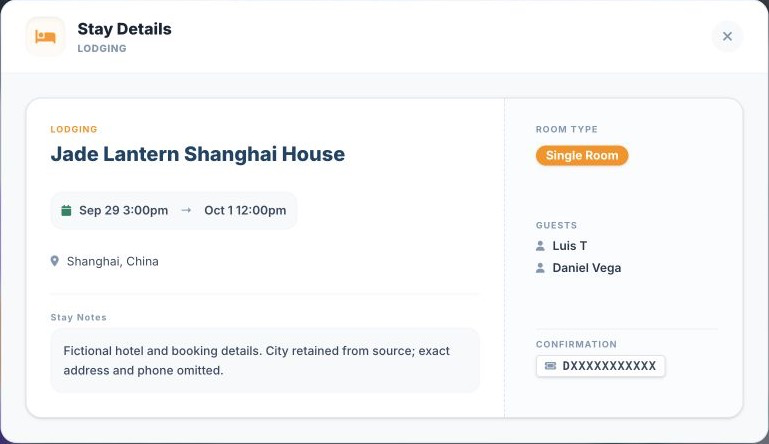
Suitcase2Go also allows you to attach important confirmation emails and uploaded documents directly to your trip file. By keeping check-in vouchers, tax breakdowns, and day-pass exemption QR codes organized in your trip plan, you can confirm exactly what is owed in seconds, sidestep payment disputes, and focus on enjoying your journey.