
Few moments at the airport cause more friction than watching a security officer pull a bag aside to inspect a bottle of perfume, skincare cream, or high-end spirits. Despite widespread headlines over recent years about next-generation 3D scanners making liquid bans obsolete, international aviation checkpoints remain heavily restricted. Traveling across multiple jurisdictions on connecting itineraries complicates the situation further.
A duty-free bottle legally purchased after security in one terminal can be confiscated two hours later at a transit screening checkpoint if you fail to observe specific international protocols. Understanding how aviation authorities govern liquids, aerosols, and gels (LAGs), how Security Tamper-Evident Bags (STEBs) function, and how to manage transit layovers ensures your travel purchases reach home intact.

The Universal Baseline: Container Volume vs. Liquid Volume
The fundamental premise governing international hand baggage screening is that regulations assess the capacity of the container, not the remaining amount of liquid inside it. Carrying a 200 ml bottle containing only 30 ml of sunscreen will result in confiscation at standard security lanes. The container itself must be manufactured to hold no more than 100 ml (or 3.4 fluid ounces in the United States).

Across international regulatory bodies, the baseline rules operate with slight jurisdictional variations:
- United States: Under the TSA Liquids Rule (commonly known as the 3-1-1 rule), each passenger is limited to containers holding 3.4 ounces (100 ml) or less. All containers must fit comfortably into a single clear, quart-sized, resealable plastic bag.
- European Union: The European Commission baseline LAGs regulations similarly restrict liquids to containers of maximum 100 ml capacity placed in a transparent, resealable plastic bag with a maximum volume of 1 liter.
- United Kingdom: The rules enforced across British airports, documented by GOV.UK Hand Luggage Restrictions, limit containers to 100 ml or less inside a clear plastic bag measuring roughly 20 cm by 20 cm that can be completely sealed.
What Counts as a Liquid?
Security screeners operate under an expansive definition of Liquids, Aerosols, and Gels (LAGs). If a substance can be poured, squeezed, spread, or sprayed, security treats it as a liquid. This includes:
- Pastes (toothpaste, styling clay)
- Viscous food spreads (nut butters, soft cheeses, jams, honey)
- Gels and creams (lip gloss, moisturizers, deodorants, sunscreen)
- Pressurized canisters (shaving cream, hairspray, setting sprays)
- Semiliquid souvenirs (snow globes, olive oil, dipping sauces)
Powders and non-viscous solids do not fall under the liquid rules, though some jurisdictions (including the U.S. and Australia) conduct secondary screening on loose powders exceeding 350 ml (12 oz).
The Reality of 3D Scanners: The 100 ml Limit Remains
Many travelers have encountered modern Computed Tomography (CT or EDSCB C3) scanners at select departure hubs. These machines produce high-resolution, three-dimensional volumetric scans of cabin baggage, allowing screeners to detect explosive threats without requiring passengers to unpack electronics or clear bags.
However, assuming you can pack full-size toiletries because an airport uses 3D scanners can lead to costly mistakes:
- European Union Policy Realignment: In mid-2024, the European Commission addressed technical detection consistency across member states. Under the European Commission temporary restrictions on C3 screening, all EU airports operating C3 scanners were required to enforce the standard 100 ml container limit while equipment software updates undergo standard review.
- United Kingdom Standardization: While several UK airports piloted higher liquid allowances, the UK government re-standardized on the 100 ml container ceiling across commercial checkpoints to ensure uniform screening standards during rolling terminal upgrades.
- United States Checkpoints: Even where the TSA has installed CT lanes that allow passengers to leave liquids inside carry-on luggage, the 3.4 oz / 100 ml volume ceiling per container remains fully in effect.
Planning Rule: Never pack a liquid container larger than 100 ml / 3.4 oz in your carry-on luggage unless you qualify for an explicit statutory exemption (such as medically necessary liquids or infant nourishment) or plan to buy the item airside under duty-free transit rules.
Duty-Free Purchases and Transit Regulations: How STEBs Work
When you purchase perfume, spirits, or cosmetics airside at an international airport, those items routinely exceed 100 ml. Carrying them aboard a single, direct, nonstop flight to your final destination is straightforward: you purchase the items past security, carry them onto the aircraft, and exit the arrival airport through customs.
The challenge begins when your journey includes a connecting flight that requires clearing a security checkpoint at an intermediate hub.
The Role of Security Tamper-Evident Bags (STEBs)
To prevent passengers from having airside purchases confiscated during international transfers, the International Civil Aviation Organization (ICAO) STEB framework created global manufacturing, sealing, and supply-chain standards for Security Tamper-Evident Bags.
A recognized STEB features:
- High-grade transparent plastic with high-visibility tamper-evident tape.
- A distinctive border showing deliberate visual evidence if unsealed, cut, or exposed to heat or solvents.
- A state or airline code identifying the origin.
- An internal or externally visible pocket holding the original itemized proof of purchase.
The 48-Hour Receipt Requirement
For a transit checkpoint to accept a duty-free liquid container exceeding 100 ml in a STEB, the purchase must be recent. Under both the TSA inbound transit policy and CATSA duty-free screening guidelines, the item must have been purchased within 48 hours (two calendar days) of the screening time. If your itinerary involves a stopover longer than 48 hours before your next flight segment, security screeners are required to reject the items.
+--------------------------------------------------------------------------+
|                       DUTY-FREE TRANSIT DECISION TREE                    |
+--------------------------------------------------------------------------+
                                      |
                     Does your trip have a connection?
                                      |
                     +----------------+----------------+
                     |                                 |
                    NO                                YES
                     |                                 |
             Direct flight:                   Where is connection?
        Carry onboard in cabin;                        |
          clear customs at dest.        +--------------+--------------+
                                        |                             |
                                  International                  U.S. / Canada
                                     Transit                       Arrival
                                        |                             |
                                  Must stay sealed              Collect checked bag
                                  in unbroken STEB              at Customs; pack
                                  with 48-hr receipt;           liquids in checked
                                  subject to rescan.            bag before re-check.
Transit Scenarios and How to Protect Your Purchases
Different connecting points present distinct logistical hurdles. Review how your routing handles transit baggage before buying duty-free goods:

Scenario 1: Connecting Through the United States
If you arrive on an international flight into the United States with an onward domestic connection (e.g., London to Dallas with a connection to Austin), you must pass through U.S. Customs and Border Protection (CBP) at your first port of entry.
- The Screening Reality: Even though TSA rules permit sealed international duty-free liquids in intact STEBs with valid receipts, the bottles must undergo secondary automated liquid bottle screening. If the bottle is made of dense, opaque, or specialty embossed glass, or if the liquid alarms the sensor, TSA agents cannot permit it through the checkpoint.
- The Safe Logistics Action: Because you must retrieve your checked baggage after passport control to clear customs, open your checked suitcase, securely pad the duty-free bottles inside your checked luggage, and place the suitcase onto the airline connecting baggage belt. This bypasses the passenger security screening line entirely.
Scenario 2: Connecting Through Canada
Similar to the U.S. model, CATSA duty-free screening protocols permit duty-free liquids packed in official STEBs purchased within 48 hours. Canadian screening officers are authorized to open the STEB, test the liquid in specialized analyzers, and reseal it in a Canadian-certified tamper bag. However, if the container cannot be cleared by the scanner, it must be surrendered. Transferring the items into checked luggage after customs clearance remains the safest approach.
Scenario 3: Airside Transit in the European Union or United Kingdom
If you transit through hubs like Frankfurt, Amsterdam Schiphol, or London Heathrow on a continuous international booking (e.g., Singapore to London Heathrow to Manchester):
- You will remain airside but must pass through flight connection security.
- Ensure the duty-free retailer at your departure airport packaged the goods in an approved, undamaged ICAO-compliant STEB with the receipt clearly displayed.
- Do not open the bag to inspect the bottles, store extra items, or discard the receipt during your initial flight.
- At the transfer security checkpoint, place the entire sealed STEB in a separate screening tray.
Practical Packing Checklist for Screenings
Following a systematic packing routine saves time at screening checkpoints and minimizes secondary searches:
- Pre-sort baseline liquids: Place all everyday toiletries into containers of 100 ml (3.4 oz) or less inside a single clear, resealable 1-liter (quart) bag before arriving at the departure airport.
- Keep liquids accessible: Unless flying exclusively from a known terminal where local instructions explicitly permit leaving bags packed, keep your liquids bag in an exterior pocket of your carry-on luggage for fast retrieval.
- Separate liquid prescriptions: Medically necessary liquids, nutritional formulas, and baby food are exempt from the 100 ml container limit in most jurisdictions. Declare these items to screening personnel before bag screening begins.
- Confirm connecting flight details before buying airside: Check whether your connection requires re-clearing security, changing terminals, or collecting checked luggage.
- Inspect the STEB seal before leaving the shop: Ensure the duty-free cashier uses an official tamper-evident bag, inserts the itemized receipt face-out, and presses the adhesive strip completely flat.
Keeping Itineraries Organized
Managing connection times, terminal transfers, and baggage re-check deadlines requires keeping flight details and layover windows organized in one place. Travelers can use Suitcase2Go to keep flight itineraries, hotel stays, and daily plans structured throughout multi-leg international journeys.
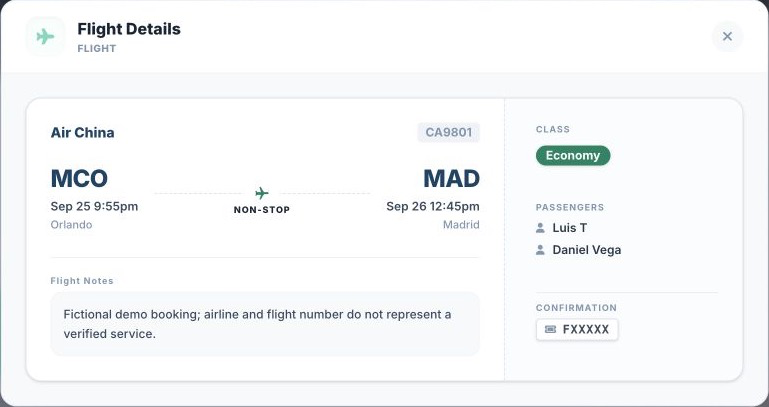
By confirming whether your transit hub requires terminal changes or customs baggage re-checks ahead of departure, you can plan your purchases carefully and navigate security screening lines without surprise confiscations.