Securing a Value-Added Tax (VAT) refund on overseas purchases sounds straightforward in theory, but at the airport, it is one of the most frequent sources of missed flights and forfeited money. Many international travelers assume that presenting a receipt at an airport tax-refund desk yields cash on the spot. In reality, the refund process is a strict, two-step bureaucratic procedure: customs validation of physical export followed by commercial refund processing.
Without a valid customs export endorsement—whether an ink stamp on physical paper or a digital green clearance on an electronic kiosk—tax refund operators cannot legally release funds. Navigating this system requires knowing where your goods are packed, which airport handles your export clearance, and how national validation systems differ.

Customs Validation vs. Refund Payout: The Essential Distinction
To avoid costly errors, keep the distinct responsibilities of government customs and commercial refund agencies separated in your planning:

- Customs (The Government Authority): Border agencies like French Customs or German Bundeszollverwaltung confirm solely that goods purchased without local sales tax are physically exiting the customs territory. Customs officers inspect your items, check boarding passes and passport details, and certify the export document. Customs does not hand you cash or manage bank transfers.
- Refund Intermediaries (Commercial Operators): Private concessionaires such as Global Blue, Planet, or merchant in-house teams handle the financial transaction. Once customs endorses your form, these desks calculate your payout, deduct administrative fees, and issue cash or trigger a card credit.
If you drop your documents into a collection box or visit a refund operator counter before obtaining your customs clearance, your claim will be rejected outright, and you will lose the refund.
Eligibility and Statutory Requirements
Under the harmonized framework of the European Commission VAT rules, travelers whose permanent residence or habitual domicile is outside the European Union can claim VAT relief on goods carried in their personal baggage. As detailed on Your Europe's consumer VAT guide, several strict rules apply across the continent:
- Export Window: Purchased goods must leave the customs territory within three calendar months following the month of purchase (i.e., by the final day of the third month).
- Condition of Goods: Items must be personal, non-commercial, and transported in accompanied luggage. They must remain unused, unaltered, and available for visual inspection by customs upon request. Do not wear the clothes or open sealed luxury cosmetic packaging before obtaining your stamp.
- Minimum Spend Thresholds: While governed under Council Directive 2006/112/EC, individual member states establish their own monetary floors.
European Thresholds and Validation Methods
| Country | Minimum Purchase Threshold | System / Procedure | Primary Official Reference |
|---|---|---|---|
| France | > €100 (in same store within 3 days) | Electronic PABLO barcode kiosks or manual customs lane | Douane France PABLO Guidance |
| Spain | €0 (No statutory minimum spend) | Electronic DIVA barcode kiosks or customs inspection | Agencia Tributaria DIVA Guide |
| Italy | €70 per invoice (lowered Feb 1, 2024) | Electronic OTELLO 2.0 digital verification | ADM OTELLO Framework |
| Germany | > €50 total delivery value | Physical customs stamp on paper export certificate | German Customs Tax-Free Shopping |
Note on the United Kingdom: Following Brexit, the UK Government abolished the VAT Retail Export Scheme in Great Britain (England, Scotland, and Wales). Visitors departing from English, Scottish, or Welsh airports cannot claim VAT refunds on goods bought in Great Britain. The scheme remains available only in Northern Ireland for eligible non-EU, non-NI residents.
The Multi-Leg Routing Rule: Checked Bags vs. Hand Baggage
The most complex logistical decision occurs when your travel itinerary includes an intermediate European transfer—for example, flying from Florence to Frankfurt, and then Frankfurt to New York.

Customs export validation must occur at the last point of departure from the common customs territory, but where your items are stowed dictates where you must validate them:
1. Checked Baggage (Hold Luggage)
If purchases are packed inside suitcases that you check through to your final intercontinental destination, you must obtain your customs stamp at the origin airport (Florence, in this example).
- Check in with your airline first, obtain your boarding pass, and tell the check-in agent that you have VAT-refund items inside your bag.
- The agent tags your bag, but you do not let it go down the conveyor belt. Instead, you take the tagged bag directly to the landside customs office.
- Customs validates your documents and examines the items. The officer or handling team then inducts the luggage directly into the airport baggage system.
2. Hand Baggage (Cabin Carry-On)
If high-value jewelry, watches, or designer goods are in your cabin bag, the goods have not legally exited the customs territory at your first airport.
- You must present these items to customs at your final transfer hub (Frankfurt, in this example) during your transit layover.
- You will process them airside (after international transfer security or near passport control) before boarding your intercontinental flight.
Planning Warning: If you have a tight connecting flight (under 90 minutes) at a major hub like Frankfurt, Paris-Charles de Gaulle, or Amsterdam Schiphol, packing refund items into carry-on baggage introduces severe missed-flight risk. If time permits, packing them securely into checked luggage and validating them at your origin airport is often logistically safer.
Decoding Automated Electronic Kiosks
Many major hubs have automated the export certification process using barcode scanning kiosks, eliminating the need to wait in line for an officer unless your scan fails.
France: The PABLO System
Found at airports including Paris-Charles de Gaulle (CDG), Paris-Orly (ORY), and Nice (NCE), PABLO kiosks scan the 2D barcode on your bordereau de vente.
- Green Screen (Bordereau validé): The clearance is registered instantly in the central customs database. No physical paper stamp or officer conversation is required. You can proceed directly to the refund desk or mail your form.
- Red Screen: Electronic clearance was refused (triggered by random compliance spot-checks, expired deadlines, or mismatched ticket data). You must step out of the kiosk line and immediately report to the adjacent customs desk with your purchases, passport, and boarding card for manual clearance.
Spain: The DIVA System
Operated by the Agencia Tributaria, interactive DIVA terminals scan the barcode on your Documento Electrónica de Reembolso (DER).
- Crucial Routing Flag: DIVA terminals will reject validation if your immediate onward flight departs for another EU destination on an unlinked reservation. Spain advises arriving at least three hours before departure to accommodate kiosk lines and subsequent refund office queues.
The Step-by-Step Airport Workflow
To ensure your tax documents are accepted and processed smoothly, execute your departure according to this sequence:
[1. PRE-AIRPORT PREPARATION]
Group merchant tax forms, store receipts, and foreign passport.
Ensure refund items are unworn and tags remain intact.
         │
         ▼
[2. AIRLINE CHECK-IN]
Inform airline counter agent: "I have VAT export goods in my checked bag."
Agent attaches baggage tags; you retain physical possession of the suitcase.
         │
         ▼
[3. CUSTOMS EXPORT VALIDATION]
Take forms and tagged bags to Landside Customs or electronic kiosk (PABLO/DIVA).
Obtain digital clearance (green screen) or physical customs ink stamp.
         │
         ▼
[4. BAGGAGE INDUCTION]
Customs accepts the bag or you return it to the oversized baggage belt.
Proceed through standard passenger security.
         │
         ▼
[5. AIRSIDE REFUND DISBURSEMENT]
Take validated forms to the refund desk (Global Blue/Planet) or drop in official post-box.
Receive cash, card refund credit, or mobile wallet transfer.
Managing Fees and Payment Traps
Securing a customs endorsement guarantees export clearance, but it does not guarantee that you will receive 100% of the statutory VAT rate.
- Commercial Deductions: Private refund operators deduct service commissions from the total tax value. If a country imposes a 20% standard VAT, your net refund will typically range between 11% and 14% of the gross purchase price.
- Cash vs. Credit Card Payouts: Airport refund desks usually charge an additional fixed fee per form for immediate cash payouts. Furthermore, if you request cash in your home currency rather than local euros, the desk applies unfavorable proprietary conversion rates. Choosing an original credit card credit minimizes currency conversion fees, though processing can take several weeks.
- Drop-Box Mailings: If refund desks are closed during late-night departures, you can place validated paper forms into designated refund operator drop-boxes. Always photograph the stamped document and keep your merchant receipts before sealing the envelope.
Keeping It Organized with Suitcase2Go
Managing multiple receipts, customs deadlines, and complex airport transit windows requires organized travel documentation. Tracking your departure schedules alongside your retail paperwork prevents last-minute scrambling.
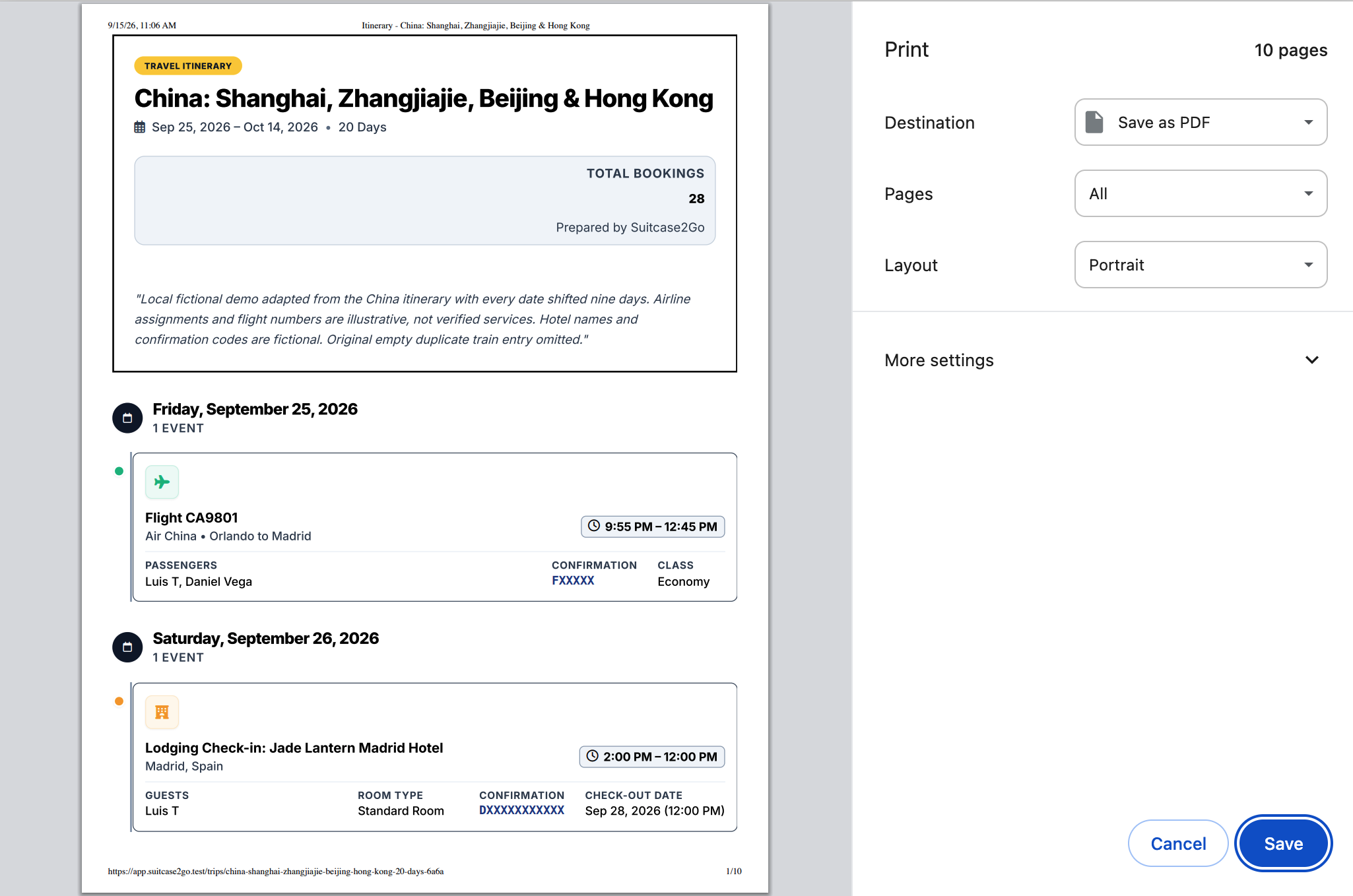
You can keep your international travel reservations structured using Suitcase2Go. Use the web platform to organize your flight segments, hotel stays, and departure itineraries in one shared view. You can upload digital copies of store receipts and merchant refund forms to your trip attachments, keep all flight confirmation details accessible before arriving at check-in, and use the print function to carry physical backup records directly to customs.