
Few travel disruptions are as stressful—or as preventable—as arriving at an airport check-in desk or an international immigration checkpoint only to discover that a critical document is missing, expired, or non-compliant. Whether you are navigating domestic airport security screening or clearing border control overseas, managing your travel paperwork requires a systematic approach rather than a last-minute scramble.
Organizing your documents effectively means balancing digital convenience with physical redundancy. Devices run out of battery, airport Wi-Fi networks fail, and border inspection officers in many jurisdictions continue to demand hard copies with official stamps. By setting up a reliable pre-departure document system, you protect your itinerary against administrative bottlenecks, border denials, and transit emergencies.

The Rule of Three: Building a Redundant System
The foundation of stress-free document management is the principle of triple redundancy. The U.S. Department of State International Traveler's Checklist explicitly instructs travelers to maintain multiple layers of documentation before leaving home:

- Original Hard Copies: Held securely on your person in a dedicated, zipped travel organizer inside your carry-on or personal item—never in checked luggage.
- Secondary Physical Photocopies: A complete set of black-and-white or color photocopies kept in a separate bag from the originals. If your primary daypack is lost or stolen, this backup set ensures you can prove your identity and expedite replacement paperwork at a local consulate.
- Encrypted Digital Copies: High-resolution scans (PDF or JPEG) stored securely on your mobile device and backed up to a secure cloud folder accessible offline.
Additionally, leave a duplicate set of photocopies and your complete itinerary with a trusted friend, family member, or emergency contact at home who can access them if you encounter unexpected transit difficulties.
Prepare for unreliable connections by carrying printed tickets or maintaining offline digital copies of ferry boarding passes, similar to the transit timing in this 5-day Santorini and Mykonos island-hopping itinerary.
1. Identity and Primary Boarding Credentials
Your primary identification governs whether you can legally board a conveyance or cross an international frontier. Audit these items well ahead of your departure date.
Passports and Validity Windows
Never assume a passport is ready for travel simply because the expiration date falls after your planned return. Many foreign governments enforce strict remaining validity buffers:
- Six-Month Validity Rule: A large number of global destinations—including many countries across Asia, the Middle East, and parts of the Americas—require your passport to be valid for at least six months beyond your planned entry or departure date.
- Schengen Area Regulations: European nations within the Schengen zone require third-country passports to be valid for at least three months beyond the intended date of departure from the Schengen territory, and issued within the previous 10 years.
- Blank Visa Pages: Most border control authorities require between two and four completely blank, unstamped visa pages for entry and exit cachets. An endorsement page in the back of a passport does not count as a visa page.
Domestic Air Travel and REAL ID Compliance
For domestic commercial flights within the United States, federal identity enforcement under the REAL ID Act is in full effect. Under TSA Checkpoint Identification Requirements, every traveler aged 18 and older must present a REAL ID-compliant state driver’s license or state identification card (designated by a star marking on the card face) or an approved federal alternative.
Acceptable alternatives include:
- A valid U.S. passport or U.S. passport card
- A DHS Trusted Traveler card (Global Entry, NEXUS, SENTRI, or FAST)
- A U.S. Department of Defense ID or active military credential
- A federally recognized tribal photo ID
While select airports support Mobile Driver’s Licenses (mDLs) at security screening lanes, the TSA continues to advise all travelers to carry their physical, compliant photo credential. Under current screening protocols, travelers presenting non-compliant IDs without approved federal alternatives face the ConfirmID identity verification process, mandatory administrative fees, and extensive secondary screening delays.
2. Visas, Entry Authorizations, and Border Registrations
Border documentation requirements have evolved rapidly into digital platforms, but physical verification remains standard operational procedure at airline gates.
Electronic Visas and Travel Authorizations
Print hard confirmations of every approved electronic travel authorization (such as the U.S. ESTA, Australian ETA, or equivalent national electronic visas). While airline reservation systems frequently communicate directly with immigration databases via Advance Passenger Information Systems (APIS), check-in agents often request to inspect physical confirmation slips during manual document checks or system outages.
Safety Alerts and Embassies: STEP Registration
Before departing on international journeys, U.S. citizens and nationals should register their itinerary through the Smart Traveler Enrollment Program (STEP). This free consular service links your trip details and overseas contact information to the local U.S. embassy or consulate nearest your destination. Enrolling ensures you automatically receive real-time travel alerts, severe weather bulletins, and security warnings, while providing consular staff with the records needed to locate or assist you during natural disasters or civil disruptions.
Streamlining U.S. Re-Entry with Mobile Passport Control
When returning to the United States through international airports or preclearance hubs, eligible travelers—including U.S. citizens, lawful permanent residents, Canadian visitors, and returning Visa Waiver Program travelers with approved ESTA authorizations—can expedite their customs declarations using the CBP Mobile Passport Control (MPC) application.
You can set up traveler profiles in the app before departure. Once your inbound flight lands, submit your inspection details and declaration electronically to access dedicated MPC lanes. Remember that mobile submissions do not replace your physical passport; you must still present your official credential to the inspecting officer.
3. Health Records, Prescriptions, and Insurance
Health-related documentation requires meticulous preparation, especially when traveling through regions with specific biosecurity requirements.
| Document Type | Format Required | Timing and Verification Notes |
|---|---|---|
| Yellow Fever Vaccine | Official physical ICVP ("Yellow Card") | Must be administered at an authorized clinic at least 10 days prior to arrival; digital photos are not legally recognized under WHO rules. Consult the CDC Travelers' Health Guidance for destination-specific mandates. |
| Prescription Medications | Original manufacturer/pharmacy packaging with label | Carry in carry-on baggage. Include a prescribing doctor's letter listing medical conditions, generic chemical names, and required dosages for controlled substances. |
| Travel Health Insurance | Printed certificate of coverage + policy number | Verify that the policy explicitly includes emergency medical evacuation, repatriation of remains, and overseas hospital direct-billing provisions. |
Review the CDC Pack Smart Checklist when assembling health documentation. Never pack routine or emergency medications in checked luggage where transit delays or lost bags can sever access to essential therapies.
Keep rental agreements and insurance details accessible, which is especially critical when reviewing rental waivers and gravel protection, as detailed in our 10-day Iceland Ring Road driving guide.
4. Transit, Lodging, and Financial Paperwork
Beyond identity and border documents, day-to-day transit logistics require immediate accessibility. Assemble these records in a dedicated physical transit envelope:

- Outbound and Inbound Flight Confirmations: Immigration officers routinely ask for proof of onward travel or return flights before granting entry stamps. Carry a printed copy of your full flight receipt showing your ticket number (e-ticket confirmation), not merely an airline boarding pass.
- Lodging and Car Rental Vouchers: In regions where mobile coverage is spotty, having the property name, local telephone number, and street address printed in the local language ensures you can direct taxi drivers or public transit operators without relying on live cellular data.
- Financial Safeguards: Carry printed records of emergency customer service phone numbers for your primary credit and debit cards, including numbers designed for international collect calls (as toll-free 800 numbers generally fail outside North America).
A Worked Preparation Timeline: T-Minus 8 Weeks to Departure
To ensure nothing falls through the cracks, pace your preparation using this phased timeline:
[T-Minus 8 Weeks]
├── Inspect passport expiration dates (ensure 6+ months buffer).
├── Count blank visa pages (minimum 2–4 pages).
└── Check visa processing windows for all destination countries.

[T-Minus 3 Weeks]
├── Schedule required travel immunizations (ICVP).
├── Request physician letters and refill controlled prescriptions.
└── Confirm REAL ID compliance for domestic routes.

[T-Minus 1 Week]
├── Register trip details via STEP (mytravel.state.gov).
├── Create digital scans (PDF) and store in secure offline folders.
└── Print physical photocopies of passport photo pages and visas.

[T-Minus 24–48 Hours]
├── Pre-fill passenger profiles in CBP Mobile Passport Control (MPC).
├── Print full return flight itinerary and lodging vouchers.
└── Pack physical documents into carry-on personal item.
Organizing Your Multi-City Plans with Suitcase2Go
Once your primary identification and border papers are compiled, centralizing the daily logistics of your journey prevents confusion across multi-city itineraries. Platforms like Suitcase2Go help travelers assemble flights, stays, and daily plans into a clear operational overview.
When managing complex travel schedules, you can use the web platform's Attachments & Emails area to record booking references, view original reservation emails, and keep track of your travel confirmations. If you are traveling with family members or friends, the Share Trip menu allows you to invite companions via email with specific viewing or editing permissions so everyone has access to the master itinerary.
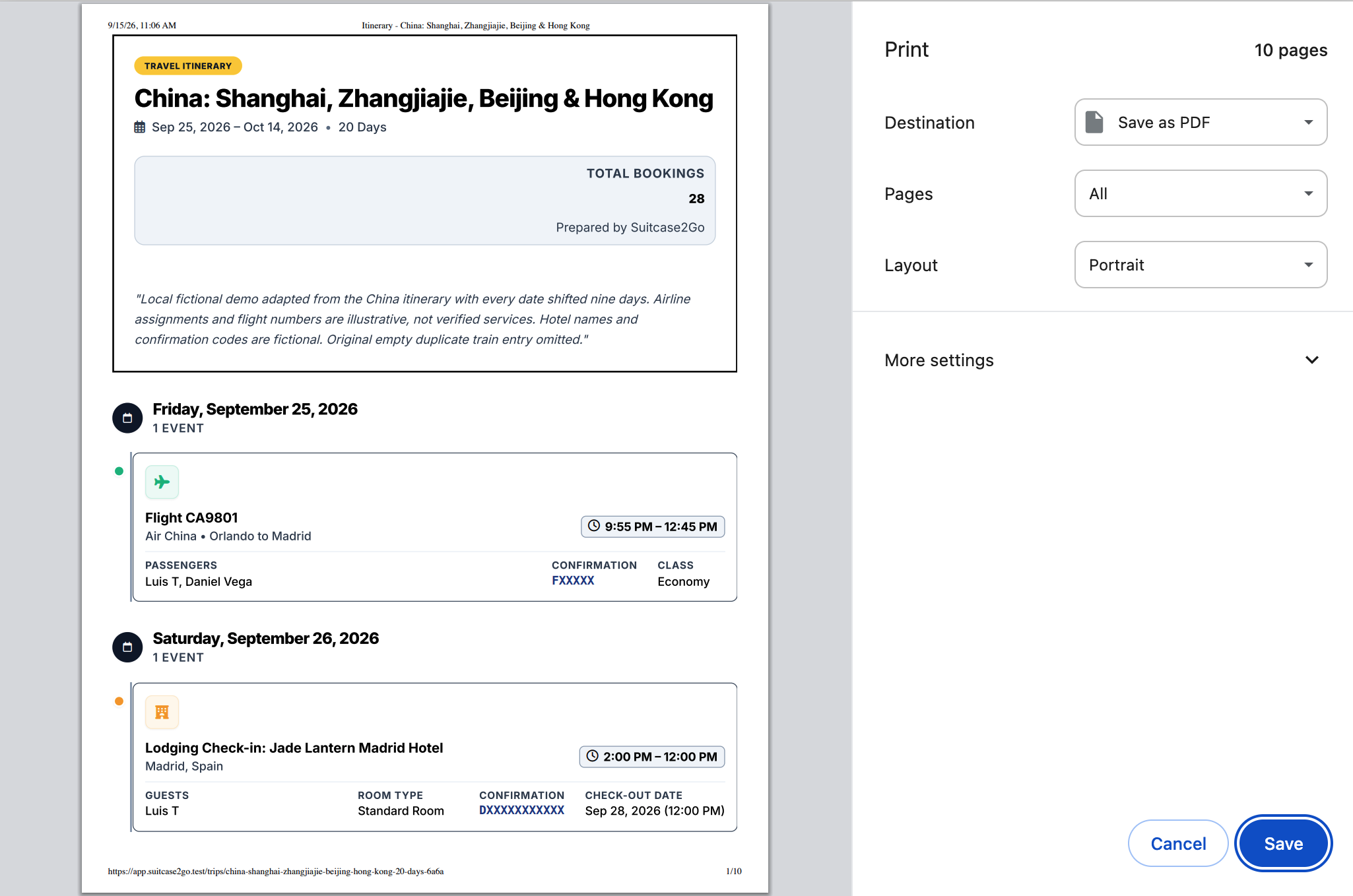
To maintain the physical redundancy recommended by consular guidelines, use the Print Trip tool to generate a hard-copy travel summary directly through your browser's print dialog, or save it as an offline reference document before you head to the terminal.
Mistakes to Avoid When Organizing Travel Documents
- Laminating Your Passport Card or Visas: Never laminate an official travel credential. Applying adhesive or thermal laminate to official documents invalidates anti-counterfeiting micro-text, holograms, and security fibers, rendering them void at international checkpoints.
- Relying Exclusively on Smartphone Screenshots: While storing screenshots of boarding passes or confirmation numbers is convenient, many dynamic airline apps frequently refresh bar codes and gate assignments. Always maintain either the active mobile application, an offline downloaded PDF, or a paper boarding pass issued at the airport kiosk.
- Splitting Travel Documents Between Travelers: When traveling as a family or group, assign primary responsibility for minor children's documents to one adult during border transit. Ensure birth certificates, notarized parental consent letters (for minors traveling with one parent or non-guardians), and passports remain grouped in a single organizer until checked at the podium.
Essential Pre-Departure Document Checklist
- Put flight, hotel, and train confirmations in one trip folder, labeled with dates and booking references.
- Check that passenger names match the travel documents used for each reservation.
- Review passport validity and visa requirements for every country on your route using official government sources.
- Save visas, insurance details, and emergency contacts alongside your itinerary.
- Download tickets and confirmation PDFs for offline access before leaving home.
- Keep a secure digital backup and a printed copy of essential documents separate from the originals.