
Nothing disrupts a carefully curated trip faster than an unexpected front of severe weather. Whether it is an unrelenting coastal downpour washing out a planned harbor tour, sudden wind gusts shutting down mountain tramways, or a cold snap making outdoor neighborhood exploration miserable, bad weather is an inevitable reality of travel. Yet many travelers still plan their itineraries as brittle, single-track schedules. When rain hits, they scramble from hotel lobbies, searching social media for indoor suggestions, only to find that popular local museums are sold out or their outdoor tour deposits are entirely nonrefundable.
A dependable travel itinerary should not crumble when conditions turn wet or windy. By treating your days as modular planning blocks and setting up verified indoor alternatives before you depart, you can pivot your daily schedule in minutes without stress, extra expense, or wasted hours. Here is a practical, field-tested workflow for structuring resilient indoor backup plans.

The Core Problem: The Brittleness of Rigid Travel Schedules
Most travelers organize itineraries chronologically: Day 1 is dedicated to a walking food tour, Day 2 to an outdoor national monument trail, and Day 3 to a botanical garden. This structure breaks down because it assumes static environmental conditions. When rain arrives on Day 2, travelers face three immediate friction points:
- Financial Lock-in: Paid outdoor excursions (such as kayaking sessions, boat charters, or guided walking tours) often enforce 24- to 48-hour cancellation policies. If you wait until rain begins to reconsider, you forfeit your booking fee.
- The Rainy-Day Crowd Surge: You are rarely the only traveler seeking shelter. Top-tier indoor cultural institutions, planetariums, and historic properties experience massive attendance spikes during bad weather. If the venue relies on capacity limits or timed passes, walk-up admissions are often turned away.
- Decision Fatigue: Scrambling to figure out transit lines, opening hours, ticket requirements, and lunch spots while sheltering under an awning leads to compromised choices and lost momentum.
Solving this requires replacing rigid daily agendas with paired contingency blocks.
Understanding Cancellation Realities and Insurance Limits
Before structuring your contingency blocks, establish what your travel bookings and insurance actually protect. A widespread myth is that standard travel insurance reimburses prepaid activity costs or missed tours simply because of continuous rain or dreary skies.
According to official guidance from Allianz Global Assistance, standard travel delay and cancellation benefits cover severe events—such as a common carrier completely shutting down operations for at least 24 consecutive hours, mandatory natural disaster evacuations, or destination accommodations being rendered uninhabitable. Unfavorable, cold, or rainy weather is explicitly excluded from standard trip-cancellation claims. To recover nonrefundable prepaid costs for voluntary weather-related cancellations, travelers generally need specialized "Cancel Anytime" policy riders, which carry higher premiums and must be secured before storms become foreseeable.
Because insurance does not protect day-to-day excursion tickets against bad weather, financial resilience must come from your booking strategy:
- Audit Cancellation Windows: When booking non-essential outdoor tours, record the exact cancellation deadline. Free cancellation typically ends 24, 48, or 72 hours prior to start time.
- Prioritize Swappable Sightseeing Products: If you plan to visit multiple major sites, consider regional multi-attraction options. For instance, the CityPASS refund and validity rules provide a consecutive nine-day validity window once activated. While unused booklets are refundable up to 365 days, the real logistical benefit is that travelers can swap indoor and outdoor partner visits across those nine days without repurchasing individual passes.
The 4-Step Modular Contingency Workflow
To build an itinerary that adapts to changing forecasts, apply this four-step planning workflow across your trip days.
Step 1: Pair Every Vulnerable Outdoor Block with a Verified Indoor Anchor
Do not make a generic list of "rainy day ideas." Instead, build direct 1:1 contingency pairs for every activity that is weather-dependent.
The National Park Service Trip Planning Guide emphasizes identifying indoor interpretive centers, park museums, and historic indoor structures as baseline contingency choices when severe outdoor conditions threaten visitor safety. These indoor anchors require minimal technical gear and keep travel parties engaged without exposure to hazardous elements.
When identifying indoor anchors in urban or regional hubs, verify their exact ticketing access models. High-profile cultural institutions often use distinct access rules that derail unverified backup plans. For example, visitor policies at the Smithsonian Institution show that while many prominent venues offer free walk-in entry, high-demand facilities—such as the National Museum of African American History and Culture and the National Air and Space Museum—mandate advance or same-day timed-entry passes. Furthermore, same-day passes are released online at specific morning windows (such as 8:15 a.m. EST). If your backup plan is to visit an indoor museum, verify whether you must log in at breakfast to claim passes rather than expecting to purchase admission at the door.
Step 2: Establish Geographic Cluster Pairing
A common mistake when swapping plans is picking an indoor alternative on the opposite side of a metropolitan area. If your primary outdoor plan was exploring an urban park district, your secondary indoor anchor must sit within that same transit cluster. This ensures that dining reservations, parking arrangements, and transit tickets remain functional regardless of whether you choose Option A (outdoor) or Option B (indoor).

Step 3: Implement the 24-to-48-Hour Forecast Review Trigger
Convective weather patterns (like summer thunderstorms or passing low-pressure troughs) shift rapidly. Checking a high-level mobile weather icon five days out rarely provides actionable clarity.
Instead, utilize precise meteorological forecasting tools such as the National Weather Service Hourly Weather Graph. The NWS digital forecasting suite displays hour-by-hour metrics across rolling seven-day periods, charting precipitation probabilities, sustained wind speeds, gusts, and cloud ceilings. Set a calendar alarm 24 to 36 hours before major outdoor activities—just ahead of your tour operator's cancellation cutoff. If the hourly graph indicates persistent rain or unsafe winds during your activity window, execute your swap before nonrefundable penalty periods take effect.
Step 4: Assemble Your Swappable Run-of-Show
Document both tracks clearly side by side so any member of your travel party can read the day's logistics at a glance.

| Day Segment | Track A: Primary Outdoor Plan | Track B: Indoor Contingency Anchor | Trigger / Decision Cutoff |
|---|---|---|---|
| Morning (09:00–12:30) | Historic Botanical Gardens & Open-Air Sculpture Walk | Regional Art Museum (Advance Timed Ticket / Flexible Voucher) | 24 hours prior (NWS hourly rain probability > 60%) |
| Midday (12:30–14:00) | Covered Central Market Food Hall (Functional in all weather) | Covered Central Market Food Hall (Functional in all weather) | No swap needed (Geographically clustered) |
| Afternoon (14:30–17:30) | Harbor Kayak Tour (24h free cancellation policy) | Historic Naval Shiphouse & Indoor Maritime Archive | 24 hours prior (Cancel kayak booking; book maritime timed entry) |
Worked Example: A 3-Day Sample Itinerary with Built-in Contingencies
To see how this framework functions in practice, review this labeled sample trip to a fictionalized coastal destination ("Port Sterling").
Day 1: Coastal Promontory & Village Exploration
- Primary Plan (Track A): Morning scenic walk along the Coastal Headlands Trail; afternoon open-air architectural photography walk through the Old Town.
- Indoor Contingency (Track B): Morning tour of the Maritime Heritage Interpretive Center (walk-in admission); afternoon visit to the Historic Vaults & Covered Guildhall (self-guided audio tour).
- Contingency Checkpoint: NWS digital hourly check at 18:00 the evening prior. If sustained winds exceed 25 mph or precipitation probability exceeds 50%, divert to Track B.
- Transit & Meals: Lunch booked at the Old Town Covered Arcade, which sits equidistant (within a 5-minute walk) from both the coastal trailhead and the Maritime Center.
Day 2: Harbor Excursion & Waterfront Parks
- Primary Plan (Track A): 3-hour guided sailing tour of the bay (cancellation cutoff: 24 hours prior for a full refund); stroll through the Waterfront Sculpture Park.
- Indoor Contingency (Track B): Morning visit to the City Aquarium (requires same-day timed reservation released at 08:00); afternoon visit to the National Glassblowing Works & Gallery.
- Contingency Checkpoint: Evaluate conditions at 08:30 the morning prior (26 hours before sailing). If small-craft advisories or steady rainfall are forecast, cancel the boat tour within the free window and note the 08:00 pass drop for the aquarium the following morning.
- Transit & Meals: Pier-side food pavilion accommodates both tracks with no reservation penalty.
Day 3: Mountain Viewpoint & Alpine Ridge
- Primary Plan (Track A): Scenic tramway ascent to Highland Ridge; picnic lunch and outdoor alpine trail walking.
- Indoor Contingency (Track B): Regional Geological Museum and Mineral Vaults; afternoon tour of the Historic Cathedral & Crypts.
- Contingency Checkpoint: Tram operations suspend if summit winds exceed 35 mph. Check summit weather station data at 07:00 on Day 3. If winds are elevated, skip the tram ticket purchase and pivot directly to the Geological Museum.
Common Mistakes to Avoid
Even with backup plans in mind, travelers frequently encounter avoidable pitfalls:
- Packing Inadequate Transit Gear: An indoor contingency only works if you can reach it comfortably. Backup planning includes carrying compact umbrellas, water-resistant footwear, and rain shells so walking between stations and venue entrances does not leave you soaked.
- Forgetting Coat Checks and Bag Rules: Major museums, galleries, and historic sites often prohibit wet umbrellas, oversized daypacks, and rain ponchos in exhibit halls. Check venue baggage and cloakroom policies in advance so your party is not delayed in entry queues.
- Overbooking Fixed Deposits on Backup Options: Do not buy two nonrefundable admissions for the same time slot hoping to use one. Your backup option should either be ticketless/walk-in, utilize a flexible multi-day pass, or feature same-day morning pass drops.
- Ignoring Midday Logistics: Choosing an indoor activity three miles away from your lunch reservation causes unnecessary stress. Always anchor both tracks to the same dining or transit hub.
Evaluating Manual Notes vs. Modern Trip Organizers
Maintaining swappable tracks requires keeping track of conflicting hours, cancellation deadlines, and alternate addresses. While a simple notebook or mobile notes document can handle a short weekend trip, multi-day itineraries with multiple participants often lead to version-control confusion, lost confirmation emails, or missed cancellation cutoffs.
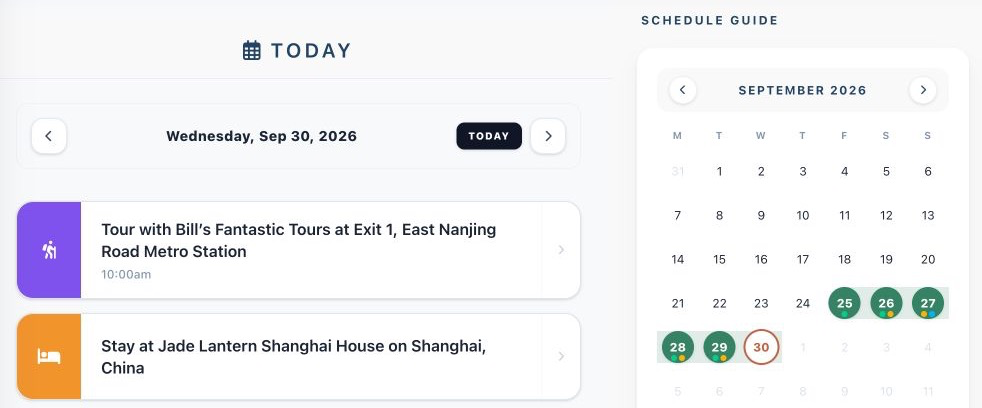
If you prefer to keep your flight times, stay confirmations, and daily activity plans structured in a single workspace, dedicated travel planning tools can streamline the process. You can explore how Suitcase2Go organizes trips with flights, stays, and daily plans in one centralized itinerary view, making it easier to review schedules, share plans with travel companions via email, and keep booking confirmations accessible whenever sudden weather shifts require an immediate pivot.
Summary Checklist: Your Pre-Trip Weather Readiness Audit
Before you set off on your next trip, run through this quick operational checklist:
- Identify Weather-Sensitive Activities: Mark every outdoor tour, boat trip, mountain ascent, or walking tour on your itinerary.
- Log Cancellation Deadlines: Highlight the exact cutoff hours (24, 48, or 72 hours) and refund terms for all paid bookings.
- Assign Geographic Indoor Anchors: Pair each outdoor activity with a verified indoor alternative located in the same neighborhood or transit zone.
- Confirm Entry Protocols: Verify whether backup venues require same-day morning pass drops, advance reservations, or open walk-in ticketing.
- Schedule Meteorological Checkpoints: Set calendar alerts aligned with official forecasting tools to evaluate conditions before cancellation penalties take effect.
By taking an hour during your pre-trip planning phase to structure swappable contingency tracks, bad weather transitions from a trip-ruining crisis into a seamless change of pace.