
Traveling with friends or extended family should focus on shared adventures, not late-night arithmetic over paper receipts. Yet when multiple people front money for rental villas, fuel, groceries, and collective dinners, tracking balances often deteriorates into confusion, forgotten debts, or tense conversations on the final morning.
A reliable group reconciliation system does not require advanced accounting skills. It requires a clear operating agreement, consistent logging habits, and a single settlement method that everyone understands before departures begin.

Step 1: Establish Ground Rules Before Anyone Swipes a Card
The most common reason group expense tracking fails is unspoken assumptions. Travelers frequently discover mid-trip that they have very different expectations regarding dining budgets, alcohol allocation, or room tiering in a shared rental.
Before confirming reservations, hold a brief planning conversation covering four fundamental decisions:

- Designate a Default Settlement Currency: If traveling internationally, agree on the single currency you will use to settle final balances. Automated ledger systems like Splitwise's Simplify Debts feature reorganize payment paths to minimize the total number of transactions between members, but they only net balances within each individual currency rather than automatically converting across currencies. Agreeing in advance on a baseline currency prevents awkward exchange-rate debates at the end of the trip.
- Define What Is Shared vs. Individual: Establish which spending categories are pooled by default (e.g., vacation rental totals, car rental charges, toll passes, shared breakfast groceries) and which remain strictly individual (e.g., personal shopping, premium alcoholic beverages, solo transit excursions).
- Decide How Unequal Lodging Costs Are Handled: In private vacation rentals, master bedrooms with en-suite baths rarely match small secondary rooms with twin beds. Decide ahead of time whether the rental cost will be split evenly across all adults or weighted according to room amenities.
- Select One Ledger Tool: Agree on one shared application or tracking sheet that everyone can access. Having half the group texting receipts while the other half logs expenses in an app inevitably leads to duplicate entries or missed payments.
Step 2: Choose the Right Tracking System for Your Group
No single tracking tool fits every travel party. Your setup should reflect your group's technical preferences and whether international currencies are involved.
Dedicated Ledger Apps (Best for Multi-Currency or Mixed Groups)
Dedicated expense trackers function as neutral ledgers where anyone can log a payment, assign beneficiaries, and view live net balances.
- Splitwise: Ideal for broader groups and multi-day domestic or international trips. Group members record transactions, assign equal or custom percentage splits, and review an ongoing audit trail via the Splitwise Recent Activity feed and export tools. The desktop interface also supports exporting a CSV spreadsheet containing row-by-row transaction amounts and balance impacts for offline verification.
- Revolut Group Bills: If group members use or are willing to open multi-currency mobile accounts, Revolut Group Bills allows users to aggregate expenses under a chosen currency, split card transactions directly from past banking history, and invite non-Revolut travelers via a web link to view balances without creating a full banking account.
Domestic Peer-to-Peer Group Features (Best for U.S.-Only Travel)
If every traveler lives in the United States and uses the same domestic payment platforms, domestic tools can combine tracking and immediate settlement in one ecosystem.
- Venmo Groups: Within the U.S. network, Venmo Groups allows up to 30 eligible personal account holders to track collective costs like lodging, gas, or group dining, automatically calculating net settlement payments. Members can split bills equally, exclude non-participants from specific expenses, or mark external cash reimbursements as paid.
- American Express Send & Split: Primary consumer cardholders with eligible U.S. consumer cards can use American Express Send & Split to split an Amex charge with Venmo or PayPal users straight from the Amex mobile app. Incoming repayments are routed back to the card account as statement credits, while the cardholder retains rewards on the total original purchase.
The Manual Shared Spreadsheet (Best for Simplicity and Privacy)
If group members prefer not to download new applications or create accounts, a shared cloud spreadsheet remains an effective alternative. Use a clean template with six columns: Date, Description, Payer, Total Amount, Included Travelers, and Category. While it lacks automated debt netting, it provides total transparency and requires no third-party logins.
Step 3: A Worked Example of Real-World Group Travel Reconciliation
To see how tracking operates during a trip, consider a fictional four-person weekend in Maine with Alex, Bianca, Carlos, and Dana.
The Transactions
- Rental Cabin: Alex books the entire property in advance for $800 (split equally among all four: $200 each).
- Pantry & Breakfast Groceries: Bianca pays $160 at the supermarket for supplies shared equally ($40 each).
- Seafood Dinner: Carlos pays $240 for dinner. However, Dana did not join because she visited local family ($80 each for Alex, Bianca, and Carlos; $0 for Dana).
- Kayak Rental: Dana pays $120 for afternoon kayak rentals for Carlos and herself only ($60 each; $0 for Alex and Bianca).
Balance Ledger
| Traveler | Total Paid Fronted | Fair Share of Spending | Net Position |
|---|---|---|---|
| Alex | $800 | $200 (Cabin) + $40 (Food) + $80 (Dinner) = $320 | +$480 (Owed money) |
| Bianca | $160 | $200 (Cabin) + $40 (Food) + $80 (Dinner) = $320 | -$160 (Owes money) |
| Carlos | $240 | $200 (Cabin) + $40 (Food) + $80 (Dinner) + $60 (Kayak) = $380 | -$140 (Owes money) |
| Dana | $120 | $200 (Cabin) + $40 (Food) + $60 (Kayak) = $300 | -$180 (Owes money) |
The Simplified Settlement
Without debt simplification, resolving this ledger would require four distinct back-and-forth payments.
By netting debits through a debt-simplification workflow:
- Bianca pays Alex $160.
- Carlos pays Alex $140.
- Dana pays Alex $180.
Total transactions needed: 3 payments instead of 4, and every traveler's balance settles to zero instantly.
Step 4: Daily Operating Habits That Prevent Reconciliation Bottlenecks
A reconciliation workflow is only as good as the discipline behind it. To keep the process effortless, adopt these day-to-day practices:
- Log Expenses the Day They Happen: Waiting until the end of a week-long journey to enter 30 separate crumpled receipts almost guarantees omitted items, lost receipts, and disputes over who attended which meal. Take two minutes before going to bed each evening to record the day's charges.
- Photograph Receipts Immediately: If an itemized restaurant check or pharmacy bill must be split unevenly later, snap a clear photo immediately. Even if you do not enter the item into the app right away, having an itemized photo avoids disputes over tax and gratuity calculations.
- Exclude Abstaining Travelers Promptly: If two travelers skip a wine tasting or a boat excursion, record their exclusion at the moment of entry. Retroactively adjusting group splits days later causes balance recalculations that confuse other members.
- Centralize Booking Confirmations: Expense tracking works best when paired with clean logistics. Having one member search text threads for a check-in code while another searches email for a rental car confirmation leads to unnecessary friction. Coordinating your logistics alongside your budget keeps the entire party aligned.
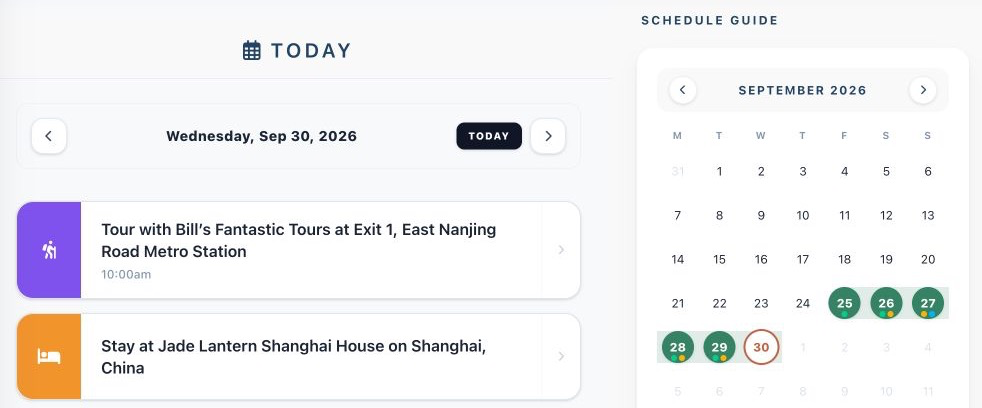
To organize your flights, lodging check-ins, and daily schedules in one shared dashboard, you can build your itinerary with Suitcase2Go. Centralizing trip details ensures every traveler knows what is scheduled, who is participating in each activity, and where reservations stand.
Step 5: Final Settlement and Auditing
Do not rush to settle debts while loading luggage on checkout day. Use a measured, three-step closing procedure:
- Declare a Final Call for Expenses: Announce a clear cut-off window (for example, 24 hours after arriving home) for everyone to enter any trailing expenses, such as airport parking, highway toll bills, or lingering fuel charges.
- Run a Brief Audit: Have each traveler quickly verify their personal total. If using a dedicated tracker, check the activity log to confirm there are no duplicate entries (such as two travelers inadvertently logging the same restaurant bill).
- Settle in One Transfer per Person: Once the ledger is locked, every member whose balance is negative sends one direct payment to their assigned recipient using their preferred payment rail (such as bank transfer, peer-to-peer app, or cash).
By establishing expectations early, maintaining daily logging discipline, and letting automated netting handle the math, your travel group can focus entirely on enjoying the journey.
