
Moving across multiple destinations in a single journey sounds romantic until you find yourself maneuvering two checked suitcases across cobblestone streets, up metro escalators, and through high-speed rail stations. For complex regional itineraries, business tours with bulky presentation gear, or trips requiring seasonal equipment like golf clubs and winter outerwear, transporting everything as standard checked airline luggage can become an operational bottleneck.
Luggage forwarding services provide a viable logistical alternative: sending your bags ahead directly to your future hotel, cruise terminal, or local depot so you can navigate transit hubs unencumbered. However, multi-city forwarding introduces distinct planning challenges, such as handling windows, receiving protocols, and international customs checkpoints. This guide explains how luggage shipping works, when to use it, and how to execute it across an intricate itinerary without missing a beat.

The Three Operational Models of Luggage Forwarding
Not every luggage delivery service operates the same way. Selecting the right service model depends on whether your itinerary is domestic or cross-border, and whether you are staying in staffed hotels or unstaffed rentals.
1. Consolidated Domestic Budget Couriers
Services like LugLess operate by securing commercial volume discounts across major domestic freight networks, primarily FedEx and UPS in the United States. Rather than providing white-glove courier support, these services offer tiered pricing where travelers generate their own digital or printed shipping labels, drop the bag at an authorized retail drop-off center, and track the item using the underlying carrier network.
This model is well-suited for cost-sensitive domestic itineraries where you have an existing buffer of several days between city stops and do not mind dropping off or collecting bags at local logistics storefronts.
2. Full-Service White-Glove Valets
Providers such as Luggage Forward and ShipGo cater to global travelers and specialized sports gear. Under this operational model, carriers coordinate doorstep pickup at your home or hotel concierge desk and route shipments internationally using proprietary customs-clearance workflows.
White-glove services often offer contractual on-time performance guarantees. For instance, Luggage Forward's On-Time Guarantee backs deliveries with a money-back commitment if bags fail to arrive by the guaranteed delivery date, provided exceptions such as severe weather or border authority customs holds do not apply. This tier is standard for travelers sending golf bags, skis, or wardrobe trunks directly to luxury resort concierge desks.
3. Integrated Regional Public Forwarding (e.g., Japan's Hands-Free Travel)
Some countries feature highly integrated, government-supported domestic forwarding systems. The gold standard is Japan's domestic network managed by carriers like Yamato Transport Global. Under their TA-Q-BIN service, travelers can send luggage hotel-to-hotel between almost any major Japanese city, drop bags at railway stations or convenience stores, or coordinate Yamato Same-Day Delivery within select metropolitan corridors.
Unlike Western domestic couriers where transit takes several business days unless expensive air priority is paid, regional networks in compact transit-heavy countries are intentionally structured for overnight hotel-to-hotel transfers.
The "Luggage Leapfrogging" Tactic
The most effective strategy for multi-city travel is known as luggage leapfrogging. Instead of forwarding your main bags to every stop on your route, you send the bulk of your belongings directly from an early hub to a later base, traveling light in between.

Consider a hypothetical worked itinerary across three destinations:
- Leg 1 (Days 1–3): Base City A (Full wardrobe, heavy luggage).
- Leg 2 (Days 4–5): Intermediate Mountain Village B (Rustic transit, trains, short overnight stay).
- Leg 3 (Days 6–9): Base City C (Extended stay, conference, or departure hub).
Attempting to drag 50-pound suitcases onto regional shuttle buses or commuter rail for two nights in Village B creates significant friction. By utilizing luggage leapfrogging, on Day 2 in City A, you ship your heavy bags directly to your hotel in City C. For Days 4 and 5 in Village B, you carry only a light, 30-liter weekend duffel or backpack. When you check in at City C on Day 6, your forwarded bags are already waiting at the front desk.
+-----------------------+           Forwarding Service           +-----------------------+
|      City Base A      | =====================================> |      City Base C      |
|     (Days 1 - 3)      |        (Bypasses Stop B entirely)      |     (Days 6 - 9)      |
+-----------------------+                                        +-----------------------+
           |
           | Light Transit (Overnight pack)
           v
+-----------------------+
| Intermediate Village B|
|     (Days 4 - 5)      |
+-----------------------+
Essential Scheduling Buffers and Holding Windows
The single most critical failure point in multi-city luggage shipping is unrealistic timing. Unlike checking a bag on an aircraft where the item flies on your exact journey, freight logistics operate on commercial transit grids.
- Schedule Arrival 24–48 Hours Ahead: ShipGo's shipping protocols specifically recommend scheduling luggage delivery one to two business days prior to your check-in date. If you arrive on Friday afternoon, your scheduled delivery window should ideally target Wednesday or Thursday.
- Verify Hotel Holding Policies: Couriers do not store bags indefinitely. Most standard hotel properties will hold guest parcels free of charge for 3 to 7 days prior to check-in, but convention resorts and downtown business hotels may impose package storage fees ranging from $5 to $30 per item. Always phone or email the destination front desk before shipping.
- Account for Carrier Cut-Offs: Scheduled pickups do not happen instantly. Standard ground services generally require morning booking or advance scheduling, while drop-offs at carrier counters must meet late-afternoon freight sorting departures.
Hotel Coordination & Delivery Protocols
To ensure your luggage reaches the secure baggage hold and does not get rejected by receiving staff, format your shipping labels precisely.

Correct Label Formatting
A hotel receiving dock may process hundreds of operational packages daily. A package addressed merely to "The Grand Hotel" with no guest context risks being set aside, redirected, or refused. Structure the recipient address as follows:
The Grand Hotel
ATTN: Guest Jane Doe (Arriving: OCT-24-2026, Conf #98765432)
123 Harbor Boulevard
City, State, ZIP
Vacation Rentals vs. Staffed Hotels
Never attempt door-to-door courier delivery to unstaffed short-term vacation rentals (such as Airbnb or VRBO properties) unless an on-site property manager has explicitly agreed in writing to receive the shipment. Delivery couriers will not wait for entry codes, and leaving bags on an unattended porch invites loss or theft.
As outlined in LugLess destination shipping guidance, when staying at short-term rentals, direct the delivery to an authorized carrier retail facility (such as a local FedEx Office or UPS Store) or a carrier access point near your accommodation, and collect the bag yourself upon arrival.
International Forwarding and Customs Realities
Shipping luggage domestically is straightforward, but international forwarding is subject to strict customs compliance. Unaccompanied luggage is classified under international trade laws as "unaccompanied personal effects," which requires specific procedural handling.
- Detailed Inventories: You cannot simply declare "used clothes." Customs agencies require an itemized packing list disclosing the contents, approximate values, and personal ownership status.
- Required Documentation: Carriers typically require a copy of your passport photo page, your international flight itinerary confirming you are traveling to the same jurisdiction, and signed customs clearance declarations.
- Prohibited Items: Hazardous materials and pressurized containers are strictly barred. According to LugLess shipping rules, items like loose lithium-ion batteries, power banks, prescription medications, aerosol sprays, perfumes, alcohol, and high-value irreplaceable jewelry must remain in your carry-on luggage and cannot be shipped.
- Customs Inspections: While services like Luggage Forward manage electronic document submission on your behalf, customs authorities retain absolute legal discretion to hold packages for manual inspection. Because delays caused by government border inspections are universally exempt from on-time guarantees, international luggage forwarding requires scheduling cushions of 5 to 10 days rather than 48 hours.
Packing and Redundancy Checklist
To safeguard your belongings across multi-carrier networks, observe three essential rules:
- Lock and Seal Appropriately: Use only TSA-recognized travel locks. For soft luggage, secure all loose straps and zippers with heavy-duty zip ties so belts do not jam automated conveyor sorting belts.
- Duplicate Exterior and Interior Labels: Shipping tags attached to handles can tear off during mechanical sorting. Keep one primary label in a clear, sealed luggage pouch on the exterior, and place a duplicate full-page paper copy of the shipping label directly on top of your clothing inside the bag.
- Retain Essential Belongings: Never forward mission-critical travel necessities. Travel documents, passports, credit cards, prescription medications, daily chargers, and at least 48 hours of baseline clothing should remain in your personal daypack.
Organizing Complex Itineraries
Tracking multiple hotel reservation dates alongside staggered luggage shipping tracking numbers, carrier drop-off receipts, and pickup locations can become confusing if left scattered across separate confirmation emails.
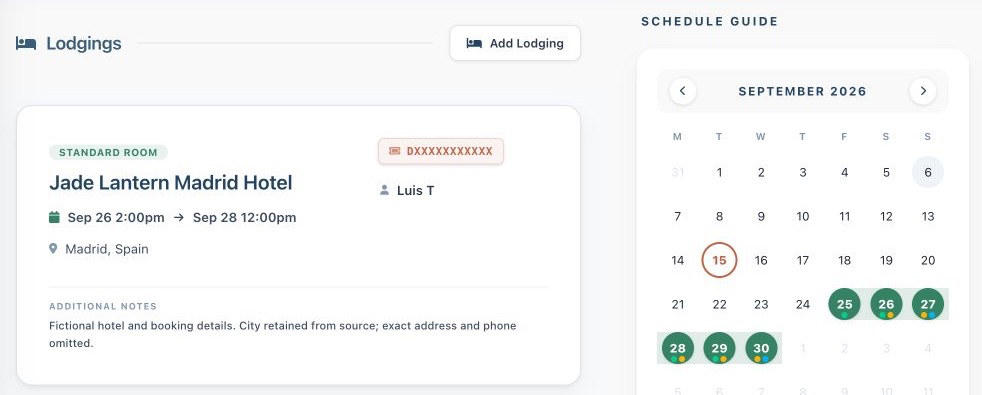
Setting up a structured trip itinerary lets you align your lodging dates with your forwarding delivery buffers. When coordinating multi-leg journeys, Suitcase2Go organizes trips with flights, stays, and daily plans in one central dashboard. Using the web trip menu, you can upload your courier receipts and hotel confirmation emails under Booking Attachments & Emails, or share itinerary details directly with travel companions so everyone knows exactly which city base your main bags are waiting in.
Step-by-Step Logistics Workflow
Follow this chronological workflow when planning a multi-city forwarding route:
- Map Out Your Multi-City Stops: Identify the transit legs where carrying heavy luggage is inconvenient (e.g., regional rail segments, short overnight layovers, or rental car transitions).
- Contact Destination Accommodations: Confirm your destination property accepts inbound guest packages, note any parcel handling fees, and record the exact front-desk delivery address format.
- Book the Shipment with Adequate Buffer: Schedule pickup or drop-off so delivery occurs 1 to 2 business days ahead of domestic check-in, or up to a week ahead for cross-border routes.
- Audit Your Contents: Remove all prohibited items, including lithium battery packs, aerosol toiletries, and daily prescription drugs.
- Tag Double-Blind: Affix the primary carrier shipping document securely to an external handle, and place a duplicate printed label inside the luggage.
- Track and Confirm: Follow the parcel tracking milestone updates. When the courier marks the luggage as delivered, contact the hotel front desk to verify the bag has been logged into their secure baggage storage before your arrival.